Technical Planning for Complex Events: From Brief to Live Delivery
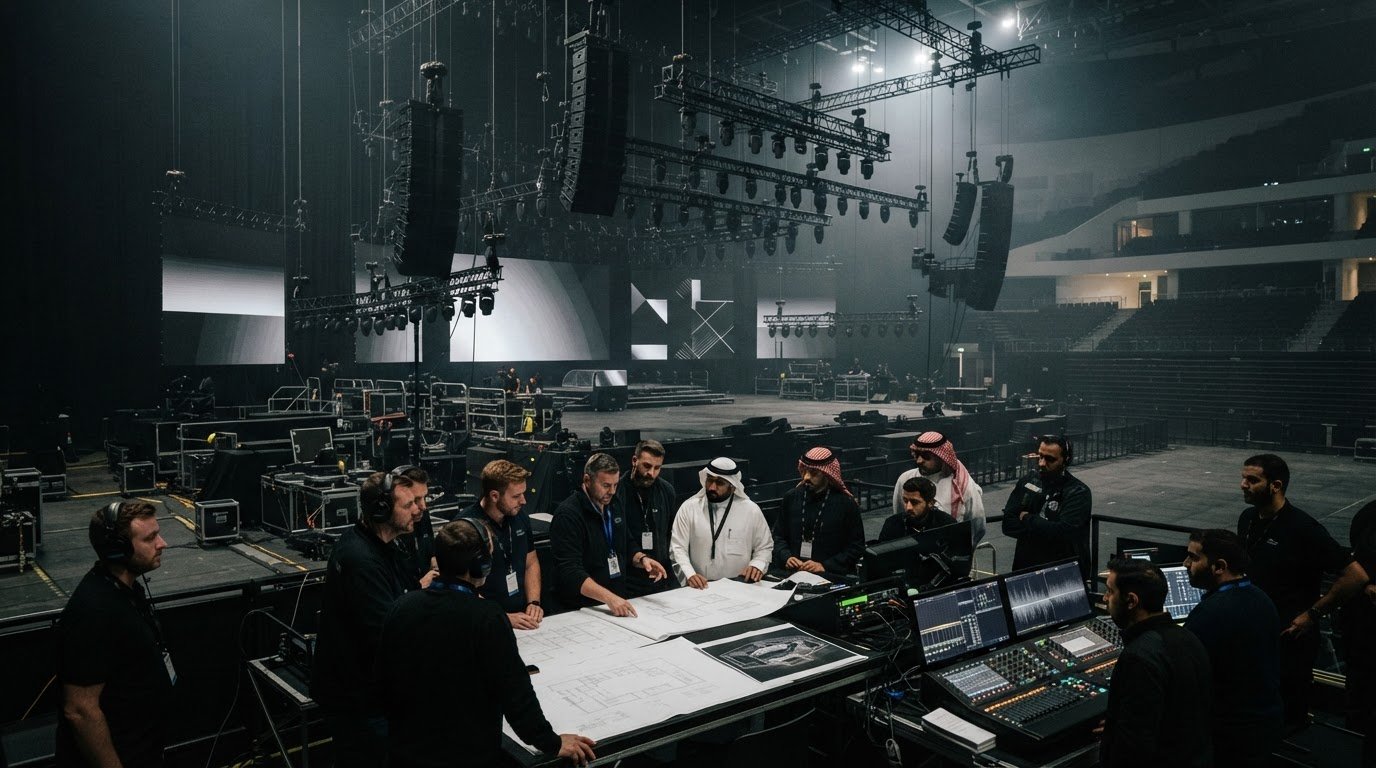
What if the best way to protect a creative vision is to make technical decisions earlier? For complex live events, the brief must connect with venue conditions, production requirements and operational responsibilities. When those threads are handled separately, dependencies can emerge late and put the plan under pressure. Technical planning for complex events is a sequence of decisions, interfaces and rehearsals, not simply a list of equipment.
The challenge is to decide what needs resolving now without locking the production into details before the concept is clear. A joined-up plan gives creative, venue and production stakeholders a shared view of requirements, decision points and ownership. It also helps teams identify what rehearsals need to test before the event goes live.
This article explains how to translate an event concept into practical technical requirements, map dependencies and responsibilities, and build a rehearsal plan that supports delivery. From the distinct contexts of Gorillaz - House of Kong and the UAE’s 50th National Day Celebration, Lar&Co’s work as “Producers of Live Entertainment” reflects the range of live productions where creative intent and technical planning need to work together.
Key Takeaways
• Turn the creative brief into clear production requirements that connect the show’s intent to delivery.
• Map how staging, sound, lighting, video, power and venue infrastructure affect one another.
• Compare options by creative value, venue impact and decision timing, without treating planning as a limit on creativity.
• Apply technical planning for complex events through adaptable gates, from gathering site information and coordinating design to readiness reviews and rehearsal.
• See how show production, technical production and site management can work alongside creative direction and financial management within one production brief.
What Does Technical Planning for Complex Events Actually Cover?
Creating a distinctive live experience means balancing creative ambition with a network of practical decisions. Staging, sound, lighting, visuals, venue conditions and operational responsibilities all need to connect. Technical planning for complex events makes those connections visible, so teams understand what must be decided, who owns each decision and which other decisions it affects.
Technical planning for complex events translates creative intent into coordinated production requirements and decisions. It covers the interfaces, responsibilities, dependencies and readiness information needed to develop and deliver a live production. It is broader than an equipment list. A list may name production elements; a plan shows how they relate, what information is needed to progress them and where a decision could affect another part of the event.
This work sits within the wider discipline of Event Management on Wikipedia, which covers the project-management principles involved in developing different kinds of events. Technical planning applies that coordination to the production itself. Early conversations between creative, production and venue stakeholders can bring constraints into view while there is still room to make informed choices, rather than uncovering dependencies during late-stage changes.
How does a creative brief become technical requirements?
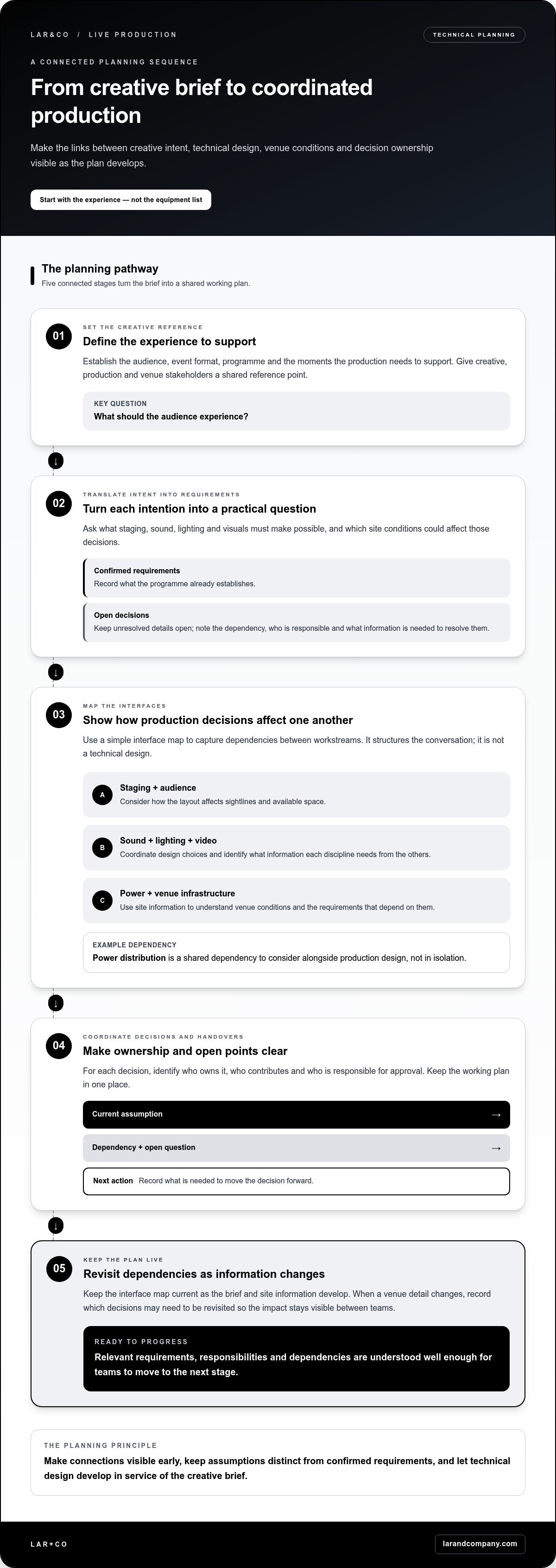
Start with the experience, not the equipment. Define the audience, event format, programme and moments the production needs to support. Then turn each intention into a practical question: what must the staging make possible? What does the sound need to communicate? How should lighting and visuals support the programme? Which site conditions could affect those decisions?
Keep confirmed requirements separate from open decisions. The programme may establish that a moment needs a visual element, while the form of that element depends on the venue or further design work. For instance, consulting AV integrators such as ETA Visual can help clarify how LED display structures interact with venue rigging and power limits. Record the dependency, the responsible stakeholder and the information needed to resolve it. This gives each discipline a clear brief without treating early assumptions as final specifications.
What makes a live event technically complex?
Complexity grows when an event’s scale, venue conditions, stakeholders and production systems interact. A change to one element may affect another, so teams need a shared view of interfaces and decision ownership. Concerts, festivals, brand experiences and cultural celebrations bring different priorities and site contexts. The planning approach should reflect the programme and place, rather than assume every production has the same requirements.
Creamfields is one example of Lar&Co’s work in a festival context. Its inclusion illustrates the range of live entertainment settings the company produces, not the event’s technical specifications. For any production, readiness means that relevant requirements, responsibilities and dependencies are understood well enough for teams to progress to the next stage. This gives the creative idea a practical route towards delivery.
How to Connect Creative Intent, Technical Design and Production Interfaces
An agreed creative brief gives every discipline a shared reference point. It describes the audience experience and intended moments, then lets technical design develop in service of those aims. Treating creative and technical work as separate streams can leave important relationships unresolved. A staging decision may shape sightlines; a visual concept may influence lighting; venue infrastructure may affect how the production can be realised. Make these connections explicit while the design is developing.
Which technical interfaces need early coordination?
Start with the stage layout and audience arrangement. Their relationship informs sightlines and helps teams consider how sound, lighting and video will serve the event. Discuss these disciplines together: a change in one design area can affect the space, placement or conditions available to another. Venue information adds another layer, including the location and capabilities of existing infrastructure. Power distribution, for example, is a shared dependency to consider alongside the production design, not in isolation.
A simple interface map can help structure these conversations. It is not a technical design or a substitute for project-specific decisions. Use it to record where one workstream depends on another:
Staging and audience
What layout is being developed, and how could it affect sightlines or available space?
Sound, lighting and video
Which design choices need to align, and what information does each discipline need from the others?
Power and venue infrastructure
What site information informs the design, and which requirements depend on venue conditions?
Keep the map current as the brief and site information develop. If a venue detail changes, record which decisions may need to be revisited. That makes the impact visible before it is missed between teams.
How should teams manage handovers and decisions?
For each decision, identify an owner, the people who contribute and the stakeholder responsible for approval. Then record the current assumption, any dependency, the open question and the next action in one working plan. This gives teams a clear handover: contributors know what information to provide, decision-makers can see what they are being asked to resolve, and everyone can distinguish settled choices from matters still in development.
Keep entries specific. “Video design depends on the agreed staging layout” is more useful than a general note that design is ongoing. A clear dependency helps teams understand why a decision matters and what must happen before related work can progress. Review the plan as designs develop and when material site information arrives.
For broader context on how technical production supports a live experience, explore this guide to technical production for live events. This joined-up approach is central to technical planning for complex events. Not every detail needs to be fixed at once, but the interfaces, owners and decision path should be clear enough to move the design forward.
Lar&Co connects creative and technical planning through its live show production work, bringing the event brief and production considerations into the same conversation.
Does Technical Planning Limit Creativity? Compare the Decisions That Shape the Show
Planning does not prescribe the creative outcome. It clarifies what a creative choice depends on, which decisions it affects and when the team needs to resolve them. That visibility can protect creative intent: stakeholders can explore options with a clearer view of the trade-offs, rather than discovering constraints after treating a direction as final.
Consider a fixed layout against an adaptable one. A fixed arrangement may give the design a clear spatial framework, whilst an adaptable approach may leave room to respond to changing programme needs. Neither is automatically better. Compare each against the intended audience experience, the site and the production requirements before deciding what to develop.
Illustrative comparison: fixed versus adaptable layout
Fixed layout
Creative value: Supports a defined spatial concept. Technical dependency: Relies on the layout being developed as a settled premise. Venue impact: Needs to be assessed against the specific site. Decision timing: Resolve once the creative direction and relevant site information can be considered together.
Adaptable layout
Creative value: Allows the concept to retain room for change. Technical dependency: Requires the team to understand what can change and what depends on the layout. Venue impact: Flexibility still needs to work within the site context. Decision timing: Define the boundaries of adaptation before dependent design decisions progress.
How can teams assess competing technical options?
Compare options against four questions: what audience purpose does this serve, how does it express the creative intent, which site conditions affect it, and what production requirements follow? Then make the trade-offs explicit. Flexibility may introduce additional dependencies, whilst a more fixed choice may narrow later options. Record whether a preference is exploratory or a confirmed requirement, and identify what information is needed to decide.
What changes between event formats and locations?
Different formats shift the emphasis. A concert may centre on the relationship between performance and audience; a festival may involve a broader site and programme; a brand experience or corporate showcase may prioritise seamless attendee collaboration, where bespoke AV providers like Averett Pte. Ltd. help design intelligent presentation and meeting environments; a cultural celebration may bring distinct programme and stakeholder considerations. These are prompts for discussion, not fixed technical prescriptions. Requirements should follow the event’s own brief.
Location matters too. Projects in the UK, USA, United Arab Emirates, Saudi Arabia and Qatar need planning shaped by their individual sites and applicable local requirements. Verify the requirements relevant to the event location rather than carrying assumptions from one market into another. This matters when comparing options: a choice that suits one venue or location may not transfer unchanged to another.
Use a decision record to keep comparisons practical. For each option, note the creative purpose, known dependencies, site information still needed, responsible decision-maker and the point at which a choice must be made. Technical planning for complex events becomes a framework for informed creative decisions, not a reason to default to the least ambitious option.
A Practical Technical Planning Workflow: From Site Information to Rehearsal
A useful workflow is built around decisions, not a fixed countdown. Each planning gate should produce something the next stage can use: an agreed brief, usable site information, coordinated design, resolved decisions or a clear view of readiness. The sequence can shift with the event format, venue and location. The principle stays consistent: do not treat a dependent choice as settled until the information it relies on is available.
Which planning gates keep technical decisions moving?
Set the event brief and initial requirements first. Then gather relevant venue and site information before treating dependent design choices as final. Use the following gates as an adaptable framework, with an owner and an output at each point:
Brief and requirements
Agree the audience experience, format, programme and intended moments. The brief owner leads this gate, with creative and production stakeholders contributing. The output is a shared basis for planning, with assumptions recorded.
Site information
Gather the venue or site details needed to develop the design. The person responsible for site information owns this gate, with relevant venue and production stakeholders contributing. The key dependency is access to information that could affect the design.
Design coordination
Bring relevant production disciplines together around the brief and site context. The design or production decision owner records interfaces, outstanding decisions and the information needed to progress them.
Decision and readiness review
Review approvals, changes and unresolved dependencies. The designated decision-makers resolve or assign open items, and the production plan records each owner and next action.
Rehearsal preparation
Confirm the programme cues and production teams involved in the rehearsal. The production lead coordinates readiness, and unresolved dependencies are surfaced before the live event.
Keep approvals, changes, open decisions and owners in an accessible production plan. A clear record helps the team see what has changed, what remains dependent on other work and who is responsible for moving each item forward. Adapt the order where the venue, programme or event format requires it, rather than forcing every production into an identical timetable.
How do readiness reviews and rehearsals support delivery?
A readiness review asks whether the information and decisions needed for the next stage are in place. It should make unresolved dependencies visible, not disguise them as completed work. Rehearsals then give relevant production teams a planned opportunity to coordinate programme cues and understand how the event moves from one moment to the next. Their focus should follow the production’s requirements.
Site-wide operations can also shape technical sequencing. Where access, site activity or coordination across the event footprint affects production, connect the technical workflow with large-scale event management. Verify applicable technical requirements for the event’s location. Do not assume that a sequence or requirement transfers unchanged between places.
For technical planning for complex events, this gate-based approach gives stakeholders a practical way to move from brief to rehearsal without relying on a universal timeline. An integrated production plan should reflect the event’s format, site and open decisions.
How Lar&Co Connects Technical Planning with Live Show Production
Technical decisions have the greatest value when they sit within the production conversation, not apart from it. Lar&Co brings show production, technical production and site management together, connecting the creative brief with the practical considerations that shape a live event. This gives stakeholders a joined-up view of the production, its requirements and the decisions that need to progress.
What does an integrated production perspective add?
Creative direction can establish the event’s ambition and inform its development, whilst technical production considers the production requirements that support that ambition. Site management brings the location into the wider planning picture. Financial management can also sit within the production brief, helping frame decisions in their broader project context. Together, these disciplines connect technical planning for complex events to the overall production, without treating any one decision as isolated.
The value lies in coordination, not in assuming that every event follows the same model. A concert, festival, brand experience or cultural celebration has its own format, stakeholders and site context. The production conversation can make those factors visible and clarify where creative direction, technical planning and site considerations intersect. Artist liaison is also part of Lar&Co’s production offering, connecting another relevant discipline to the wider live-event brief where needed.
Lar&Co, “Producers of Live Entertainment”, works across varied live-entertainment contexts. Its confirmed productions include Gorillaz - House of Kong, Adele World and Creamfields. These examples indicate the range of work without implying specific technical methods, specifications or outcomes. The company’s primary locations in London and Los Angeles provide context for its international practice. Lar&Co’s live entertainment work offers a view of that breadth across productions.
How can a project move from planning to a production conversation?
Begin with the essentials: the event’s ambition, format and location. Bring together the stakeholders who can speak to creative intent, production requirements and site considerations. Existing venue or site information is useful context, as are known constraints and decisions that remain open. This gives the initial discussion a practical focus without requiring every detail to be settled in advance.
A clear starting brief can also identify what the production needs to understand next. Which choices are central to the audience experience? What information is already available about the location? Where do creative, technical and operational considerations overlap? These questions help frame the work and show where further planning is needed. The answers will be specific to the production, not drawn from a standard template.
When preparing a brief, bring the event ambition, format, location and available site information into one view. That makes it easier to identify which decisions are ready to progress and which still depend on further information.
Give the Live Vision a Clear Route Forward
Start by bringing the event ambition into focus. Decide what the audience should experience, what is already known about the format and location, and which choices still need to be made. That gives creative and production stakeholders a useful starting point for turning ideas into a connected plan.
Lar&Co’s portfolio spans music, brand and cultural productions, including Gorillaz - House of Kong, Adele World and Creamfields. With primary locations in London and Los Angeles, Lar&Co works across international live entertainment. Each production has its own context, but the value of technical planning for complex events lies in giving creative intent a considered path towards live delivery.
Bring the ambition, known constraints and key stakeholders into the conversation. Discuss a live production with Lar&Co and take the first step towards shaping a production plan that supports your vision.
Frequently Asked Questions
What is technical planning for a complex event?
Technical planning for a complex event turns the intended audience experience into connected production decisions, rather than simply selecting equipment. For example, a programme that moves between different types of moments may require teams to consider how transitions affect staging, cues and venue use. The precise scope depends on the event format, venue and project context, so the plan should reflect the production rather than follow a generic checklist.
When should technical planning begin for a live event?
Begin as the event brief and core requirements take shape. Early creative decisions can influence venue enquiries, design development and the information production teams need, so leaving planning until those choices are settled may narrow the options. There is no universal lead time: scale, format, location and how decisions are made all affect timing. A useful test is whether a decision could shape another workstream and therefore needs attention early.
What information should a venue technical pack contain?
A useful venue pack brings together available site plans, information about venue infrastructure, access details and known technical constraints. It can also identify which information is provisional or still needed, so production decisions are not based on assumptions. The exact contents vary by venue and event. For instance, a production using several areas of a site may need information relevant to each area, whilst a single-space event may raise different planning questions.
What is the difference between a technical rehearsal and a dress rehearsal?
A technical rehearsal generally concentrates on coordinating production elements with programme cues. A dress rehearsal usually adds relevant performance elements in their intended sequence, giving teams a chance to work through the event more fully. The distinction is not identical across every production: rehearsal formats depend on the programme, participants and what needs to be tested. Agree the purpose of each rehearsal in advance, so contributors understand what the session is designed to address.
How should technical planning account for accessibility?
Include accessibility in conversations about the audience experience, venue layout and production choices from the outset. A practical discussion might consider how the event’s spaces and programme serve the people attending, and whether planned elements create barriers that need addressing. Requirements vary with the audience, event and location, so one measure will not suit every production. Verify applicable local requirements for the event’s jurisdiction rather than assuming the same approach applies everywhere.
How do technical plans adapt when an event spans multiple countries?
Build the plan around each event location’s venue, operating context, stakeholders and applicable local requirements. A production spanning the UK, USA, United Arab Emirates, Saudi Arabia and Qatar may need separate location-specific information and decision routes, even where the creative concept is shared. Keep a clear record of what applies at each site, and verify relevant requirements locally. Do not assume that arrangements or decisions made for one country transfer unchanged to another.