Post-Event Analysis and Reporting Framework: A Practical Template

A post-event report can record everything that happened and still leave the most important question unanswered: what should change next time? A practical post-event analysis and reporting framework connects evidence to decisions, rather than treating attendance, feedback and spend as results in themselves.
Information is often spread across production teams, suppliers, audience responses and financial records, while stakeholders need different levels of detail. Without a clear structure, a report can become a catalogue of activity instead of a fair account of what worked, what did not and why.
This guide sets out a reusable framework, with prompts for each report section. The framework guides the process and links findings to objectives; the template shapes the finished document. You’ll also see how to compare aims with evidence and outcomes, state limitations, tailor reporting for different audiences and prioritise actions for future live productions. The result is a report built to inform the next decision, not simply close the last event.
Key Takeaways
• Build your post-event analysis and reporting framework around clear objectives, relevant measures, evidence sources and accountable contributors.
• Compare intended outcomes with observed evidence, then record the variance, possible explanations and confidence in each interpretation.
• Use a practical report outline to present findings, limitations and recommendations in a format stakeholders can act on.
• Turn each key finding into an action with a clear implication, next step and owner.
• Carry agreed actions into future creative, technical, operational and financial planning through a focused review and retained record.
What a Post-Event Analysis and Reporting Framework Should Answer
A post-event analysis and reporting framework organises evidence, interpretation and decisions after an event. It gives the team a disciplined way to move from what happened to what it means, then decide what should happen next. Analysis examines the evidence. Reporting communicates the findings to the people who need to use them.
That distinction matters. A report can list attendance, audience comments and costs without showing whether the event fulfilled its purpose. Assess success against the objectives agreed at the outset. If the aim was to encourage repeat visits, attendance alone will not show whether that happened. The evidence needs to relate to the objective.
How analysis, evaluation, and reporting differ
Analysis examines collected evidence against agreed objectives and measures. Evaluation judges the significance of that evidence: how well the event performed, what shaped the result and what can be learned. Reporting presents those conclusions and proposed actions clearly for relevant stakeholders. Together, these stages make findings more useful than a record of activity. They also reflect the broader event cycle outlined in the Event Management Overview.
Which questions should the framework answer?
Use the framework to keep the discussion focused on evidence and decisions. Ask:
• Did the event meet its original objectives, and what evidence supports that conclusion?
• What worked, what underperformed, and which contextual factors may have influenced the result?
• What should be repeated, adapted or investigated before another production?
For each answer, separate what the evidence shows from what the team believes may explain it. A drop in attendance at one part of a programme is an observation. A claim that the timing caused the drop is an interpretation, and may need more evidence before it informs a major change.
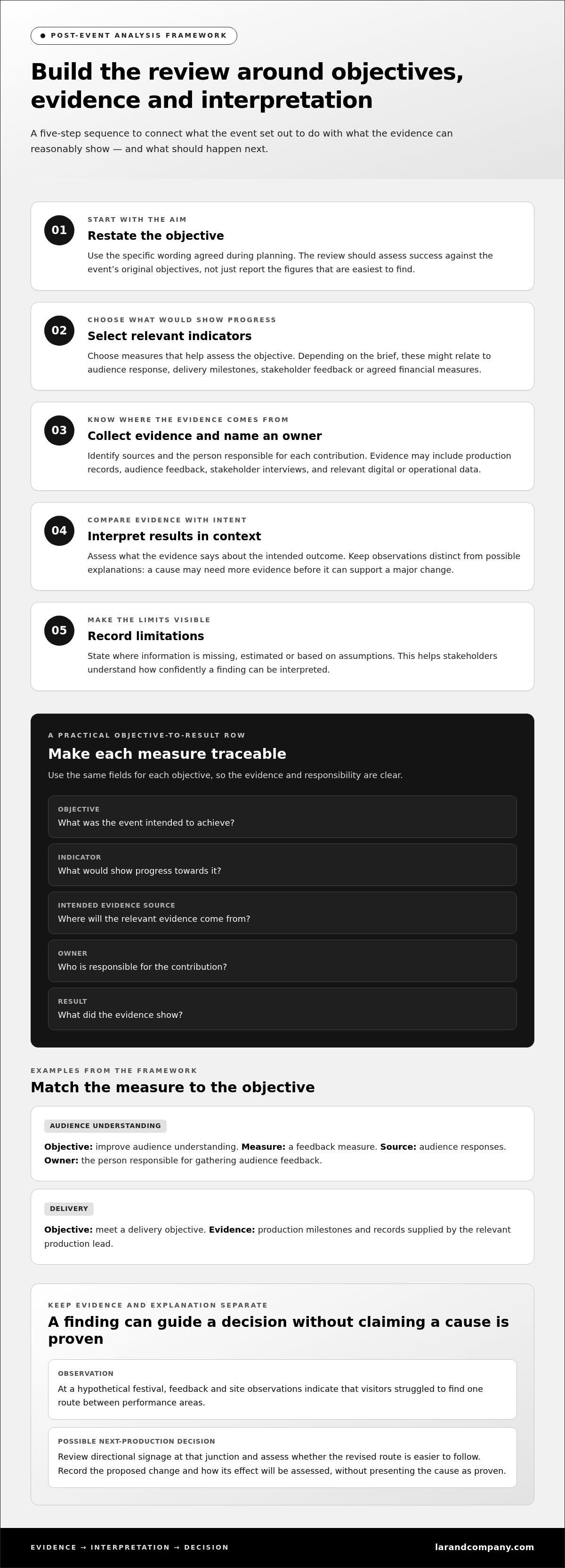
Consider a hypothetical festival with an objective to help audiences move between performance areas. Feedback and site observations indicate that visitors struggled to find one route. The finding could prompt a specific decision for the next production: review directional signage at that junction and assess whether the revised route is easier to follow. Record the observation, proposed change and how its effect will be assessed, rather than presenting the cause as proven.
The framework should be consistent in its logic, but tailored to the event’s scale, format, stakeholders and aims. A concert, festival, cultural celebration and brand experience may require different evidence and measures. A useful structure makes room for those differences while keeping the central questions constant: what was intended, what happened, what can reasonably be concluded, and what decision follows?
That balance gives production teams a shared basis for learning. It connects creative, technical, operational and financial considerations without assuming that one measure defines success. The aim is not to produce a longer account, but to make the next production decision clearer.
Build the Framework Around Objectives, Evidence, and Interpretation
A useful post-event analysis and reporting framework follows a clear sequence. Start with the objectives agreed before the event, then identify relevant indicators, gather evidence, interpret results and record limitations. This keeps the review focused on what the production set out to achieve, rather than whichever figures are easiest to access afterwards.
For each objective, decide what would count as evidence and who can provide it. Measures will vary by brief: audience response may matter for one event, while delivery milestones, stakeholder feedback or agreed financial measures may be more relevant to another. Include creative, operational and technical perspectives when they help answer the objective.
Restate the objective
in specific terms, using the wording agreed during planning.
Select indicators
that show progress towards that objective.
Collect evidence
from identified sources, with a named person responsible for each contribution.
Interpret results
against the intended outcome and relevant context.
Record limitations
, including missing information, estimates and assumptions.
Map objectives to useful event measures
Use a simple row for each objective: Objective | Indicator | Intended evidence source | Owner | Result. For example, an objective to improve audience understanding might use a feedback measure, with audience responses as the source and the person responsible for gathering audience feedback as the owner. A delivery objective could map to production milestones and records supplied by the relevant production lead. A measure is useful only if it helps assess an agreed objective.
Financial measures should also relate to the brief, rather than appear simply because figures are available. A stakeholder objective might be assessed through structured feedback, while a creative objective could require considered qualitative responses. Not every production needs every perspective. Select the evidence that gives a credible view of the stated aims.
Gather and qualify evidence across production teams
Evidence may include production records, audience feedback, stakeholder interviews, and relevant digital or operational data. For each item, record its source, collection period, owner and known limitations. Note whether a result is a direct count, an estimate or a summary of responses. If feedback represents only one audience group, state that plainly.
Then compare quantitative measures with qualitative context. A milestone record can establish whether a task was completed, while a team debrief may explain constraints that shaped delivery. Neither is a complete account on its own. Keep observed results separate from possible explanations, and flag contextual factors or evidence gaps where they affect confidence in the interpretation.
This discipline makes findings more usable across complex productions, from festivals and concerts to cultural celebrations and brand experiences. It also supports practical planning across creative, technical, operational and financial work. For examples of live production across different contexts, explore Lar&Co’s live production work.
Compare Results Fairly: What Worked, What Fell Short, and Why
A fair comparison makes the gap between intention and outcome visible without turning an interpretation into a fact. For each objective, use a consistent row with six fields: objective, intended outcome, observed evidence, variance, explanation and confidence. This creates a clear record of what was planned, what the evidence shows and how firmly the team can explain the difference.
For example, a festival objective might be to make movement between programme areas straightforward. The intended outcome could be that audiences can locate the next area easily. The observed evidence might include audience comments and site observations. If feedback points to confusion at one junction, record that as the variance. A possible explanation could be unclear wayfinding, but mark it as a hypothesis unless the evidence supports that cause.
In the confidence field, state whether the explanation is well supported, plausible but unconfirmed, or uncertain. This distinction helps decision-makers judge what can be acted on now and what needs further investigation.
Objective
the agreed aim being assessed.
Intended outcome
what success was expected to look like.
Observed evidence
the records or feedback available.
Variance
the difference between intention and result.
Explanation
the factors that may account for the difference.
Confidence
how strongly the evidence supports that explanation.
External conditions, scope changes and incomplete data belong in the comparison, but they should not become automatic explanations for every shortfall. Record what changed, when it changed and which objectives it could reasonably have affected. Then assess the evidence against the revised context. If a programme change reduced the time available in one area, for instance, that may help explain a delivery variance. It does not establish that every related outcome was caused by the change.
A consistent structure need not make every event look the same. A useful post-event analysis and reporting framework holds the comparison fields steady while allowing project-specific objectives and measures. That flexibility matters in live entertainment, where a concert, festival or cultural celebration may have different creative, audience, operational and financial priorities.
Each perspective calls for relevant evidence. A creative objective might be assessed through considered audience and stakeholder responses. An audience objective could draw on feedback or observed participation; for complex brand installations or interactive exhibits, solutions from Ergoneers can provide objective behavioural data to support those evaluations. Operational aims may relate to delivery records, while financial aims should be assessed against the measures agreed for the production. Do not compare feedback across audience groups unless the collection method and available responses make that comparison meaningful.
Use careful language to distinguish correlation from cause. “Audience feedback and queue delays occurred during the same period” describes an association. “Queue delays caused lower satisfaction” makes a causal claim and needs supporting evidence. State what the data shows, what contextual information adds, and what remains outside the analysis. Where evidence is incomplete, identify the gap rather than presenting a confident conclusion.
Use This Post-Event Report Template to Turn Findings Into Actions
A report is useful when readers can move from the headline to the evidence, then from the evidence to a decision. Use this outline as the document layer of your post-event analysis and reporting framework. Keep the structure consistent, but adapt the detail to the production and its stakeholders.
Executive summary
State the event’s objectives, the most important findings and the priority actions. Keep this concise for senior decision-makers.
Objectives
Record the agreed aims and intended outcomes, so readers can see what performance is being assessed against.
Evidence
Identify the measures, sources, collection periods and owners behind the findings.
Findings
Compare outcomes with objectives, explain meaningful variances and distinguish evidence from interpretation.
Limitations
Note gaps, estimates, unresolved questions and other factors that affect confidence.
Recommendations and owners
Set out decisions or actions, their priority, accountable owner, timing and review point.
What to include in each report section
The executive summary should give leaders enough information to understand what matters without requiring them to read every supporting detail. The main body serves production teams and other stakeholders who need to assess the evidence, understand variances and follow the reasoning behind each recommendation. Keep source notes or supporting records accessible, and make clear which conclusions rely on limited evidence.
Use the same concise structure for each finding: evidence, interpretation, implication, recommended action and accountable owner. For example, evidence might show repeated audience comments about difficulty locating a programme area. The interpretation should state what those comments suggest, while the implication identifies the potential effect on the experience. A recommendation could be to review the relevant wayfinding plan before the next production, with a named owner responsible for bringing a proposal to a specified review point.
Report limitations alongside the finding, not in a distant appendix where they are easy to miss. If feedback came from only one part of the audience, say so. This allows readers to judge the conclusion at the right level of confidence.
How to make recommendations specific and usable
A recommendation should describe a decision or action, not simply repeat an observation. “Improve communication” gives no clear next step. “Add a daily schedule check between the site and programme leads during planning” is more actionable, provided the evidence supports that response. For every agreed action, record priority, timing, owner and review point. Set priority by relevance to the next production, not convenience.
Lar&Co, Producers of Live Entertainment, produces concerts, festivals, brand experiences and cultural celebrations, each with distinct objectives and stakeholders. Its production work includes creative direction, technical production, site management and financial management. A consistent report template can accommodate those project-specific measures without changing its core logic.
When planning a live production, set objectives that can guide delivery decisions and make the eventual review useful.
Make Post-Event Reporting Part of the Next Production Cycle
A report only earns its place if its lessons reach the next brief. Close the review with a short meeting involving the people responsible for acting on its findings. Confirm which decisions are agreed, assign an owner to each action and set a point to review progress. Retain the report alongside the relevant planning records so the reasoning travels with the recommendation, not just the headline.
This final step completes the post-event analysis and reporting framework. It turns conclusions into material the next production team can use, while making clear which lessons are established and which questions remain open.
Carry lessons into the next brief and production plan
Translate each agreed lesson into a future objective, planning assumption or production action. A finding about a technical handover, for instance, might lead to an earlier coordination milestone in the next plan. Preserve the context: what was observed, what evidence informed the decision, and why the action was chosen. Without that record, a future team may inherit a rule without understanding the circumstances behind it.
Keep unresolved questions visible. If the evidence points to a possible issue but does not establish its cause, assign someone to investigate it before the next relevant decision is made. A brief handover record can capture the question, its owner and the planning milestone by which an answer is needed.
The lesson may inform different parts of the next production. Creative findings can shape the brief; technical findings can prompt a review of requirements and handovers; operational findings can influence site planning; and financial findings can guide assumptions used in future planning. This is not a substitute for specialist guidance on those disciplines. It ensures relevant post-event learning is carried into them.
When experienced production oversight adds value
Complex live productions bring creative intent, technical delivery, site requirements and financial considerations into close relationship. Production management helps teams consider these perspectives together when translating a lesson into a practical decision. The right response may involve coordination across several areas, rather than a change to one isolated task.
The production context will shape which lessons matter. Lar&Co’s work includes festivals such as Creamfields and brand experiences such as Gucci Cosmos. These examples illustrate the range of live entertainment contexts, not specific reporting outcomes. A broader global show production strategy can also help frame how decisions connect across a production.
For productions involving teams in the UK, USA, United Arab Emirates, Saudi Arabia or Qatar, make the relevant local context, roles and evidence sources clear in the report. This helps stakeholders understand how a decision relates to the production and the teams responsible for delivery.
Before the next cycle begins, revisit the retained record and carry forward only the actions that remain relevant. Give each one a place in the brief or plan, with an owner and a review point. That keeps learning active rather than archived.
Make the Next Production Stronger
The value of a post-event analysis and reporting framework lies in what it makes possible next: better-informed choices, with the reasoning behind them preserved. Treat each production as a source of practical intelligence. A clear record helps teams carry forward what matters, challenge assumptions and shape the next brief with greater intent.
That perspective is relevant across the range of live entertainment. Lar&Co’s portfolio spans concerts, festivals, brand experiences and cultural celebrations, including Gorillaz - House of Kong and Adele World. Each production brings its own creative ambition and delivery context. The right decisions start with understanding both.
Lar&Co, Producers of Live Entertainment, provides show production for complex live projects. A clear framework helps preserve what each production teaches and carry relevant decisions into the next brief.
Frequently Asked Questions
What should a post-event analysis report include?
Include the event’s purpose, the evidence used to assess it, key findings, unresolved limitations and the decisions that follow. Give each finding enough context to stand on its own, such as the relevant programme element, audience group or delivery phase. A short glossary can help when teams use internal terms or measures differently. Keep supporting records available for readers who need to verify how a conclusion was reached.
How soon after an event should you write the post-event report?
Issue a brief flash report within 48 hours of the event ending, then complete the fuller report within two weeks. The early update can share confirmed headlines and flag what is still being compiled. Avoid presenting provisional figures as final. The full report can incorporate reconciled records, considered feedback and context from the production team, with any changes to initial findings clearly identified.
What is the difference between post-event analysis and post-event evaluation?
Analysis examines the available information and identifies patterns or differences. Evaluation considers what those findings mean for the event’s objectives and performance. For example, analysis might show that one programme area received fewer visits than another; evaluation would consider whether that matters in light of the event’s aims and what other evidence helps explain it. Keeping the steps distinct makes it easier to see where evidence ends and judgement begins.
Which KPIs should be included in a post-event analysis?
Choose indicators that relate directly to the event’s agreed aims. Depending on the brief, these might include attendance against the planned audience, audience feedback on a particular experience, completion of key delivery milestones, or financial measures set for the production. Do not add a KPI simply because a platform supplies it. For a multi-day festival, for instance, a daily attendance pattern may be more informative than a single total if the objective concerns programme reach.
How do you measure whether a live event was successful?
Assess success against the event’s stated objectives, using evidence suited to each one. Attendance can show reach, but it will not by itself demonstrate audience satisfaction, creative impact, smooth delivery or financial performance. Consider whether the planned experience was delivered, how relevant stakeholders responded and what the agreed measures indicate. An event can meet one objective and fall short on another, so report performance by aim rather than forcing a single overall verdict.
How can you report event results when some data is missing?
Report the gap plainly and explain which conclusions it affects. Separate verified figures from estimates, and do not use an incomplete sample to make claims about the whole audience. For example, if feedback was gathered from one performance period only, identify that scope and limit the conclusion accordingly. Note whether the missing information can be recovered, who will investigate it and whether the gap should change the confidence or action attached to a finding.
Who should receive a post-event report?
Share the report with people who need to make decisions or deliver follow-up actions. Senior leaders may need a concise view of objectives, implications and priorities; production teams may require operational detail; sponsors or other stakeholders may need information relevant to their agreed interests. For productions involving teams in the UK, USA, United Arab Emirates, Saudi Arabia or Qatar, make roles and local context clear, and share only information appropriate to each recipient.
How do you turn post-event findings into actions for the next event?
Convert a finding into a decision or task that can be placed in the next brief or production plan. Specify what will change, who is accountable and when progress will be reviewed. For example, if a handover caused a delay, the next plan might include a defined sign-off point before the affected work begins. Retain the reason for the action, so the next team can assess whether it remains relevant rather than applying it without context.
To discuss your next live entertainment production, contact Lar&Co.