Managing Complex Event Logistics: A Framework for High-Profile Live Events
More checklists won’t keep a complex live event aligned. The pressure comes when teams and suppliers work from different versions of the plan, and one decision or delay affects what several others can deliver. Managing complex event logistics means making those dependencies visible and giving each decision a clear owner.
Keeping operations aligned from early planning through live delivery takes more than adding updates. Teams need shared clarity: who holds the latest information, who can make a decision, and how an issue should be escalated. This becomes especially important when work spans international locations and different operating contexts.
This article sets out a practical framework for connecting people, locations and operational decisions, so stakeholders can act with confidence and the live experience feels composed. It covers how to map dependencies, establish ownership and escalation routes, and keep teams working from a coherent plan. Lar&Co, Producers of Live Entertainment, brings production oversight to concerts, festivals, brand experiences and cultural celebrations.
Key Takeaways
• See why live entertainment creates connected workstreams, where a change in one area can affect the wider production.
• Use a practical framework for managing complex event logistics: define outcomes, map workstreams, assign owners, connect dependencies and set decision points.
• Use checklists and software to support delivery, while keeping accountable decisions at the centre of the plan.
• Structure coordination around advance planning, readiness reviews, live updates and closeout.
• Discover how Lar&Co brings show production, technical production, site management and creative direction together around a shared delivery plan.
What makes managing complex event logistics different for live entertainment?
Complex event logistics is the coordination of interdependent workstreams so people, places and decisions come together for one live-show outcome. Success depends not only on completing tasks, but on completing them in the right order and in coordination with one another.
A single-venue event may have a contained programme and fewer operational connections. A high-profile live production can bring together creative, technical, venue and operational teams, alongside suppliers and other stakeholders. More handovers mean more opportunities for information to become out of date. Meanwhile, audience-facing moments have a fixed context: doors open, the performance begins and the experience unfolds to a schedule. A disconnected decision can quickly affect other parts of delivery.
Broad Event Management Principles cover the planning and coordination involved in delivering an event. Live production adds a sharper requirement: workstreams must stay aligned as the plan moves towards a shared moment of delivery.
Which factors make live-event logistics complex?
Venue, technical, creative and operational plans are distinct, but none sits entirely alone. A programme change may affect when a space is needed, which can alter when another team can complete its work. The impact travels through dependencies, not just down a task list. Identify those connections early to see which decisions have wider consequences and where timing needs active coordination.
Stakeholders need aligned schedules, current information and clear routes for decisions. If one team works from an earlier plan, another may prepare for a moment that has shifted. International locations add another layer: teams may be working across time zones, unfamiliar contexts and different local rhythms. For productions involving the UK, USA, United Arab Emirates, Saudi Arabia or Qatar, make shared priorities and decision routes clear without assuming that every location operates in the same way.
How is production logistics different from a task list?
A task list records actions: prepare a space, approve a creative element, complete a technical check. It helps track progress, but does not show how actions rely on one another. Production logistics connects them to shared deadlines, resources and milestones, making it easier to see where one workstream’s timing affects another’s ability to proceed.
Consider a change to the running order. It may look like a simple programme edit, but it could influence creative cues, technical preparation, venue timing and the information shared with stakeholders. Not every adjustment creates a crisis. Teams do need to recognise its reach, identify who owns the next decision and communicate the agreed change consistently. That is what turns separate activity into coordinated delivery.
Managing complex event logistics means seeing the production as a connected system. Make dependencies visible before they become delivery issues, and keep ownership clear as plans evolve.
Build an integrated event logistics plan around owners and dependencies
A useful plan does more than gather dates and tasks. It shows how work connects, who is accountable for each area, and where a decision in one workstream could affect another. This is the foundation for managing complex event logistics without relying on separate teams to reconcile changes themselves. A broad overview of Understanding Event Logistics can help define the operational scope; a production-wide plan also needs to make the links between those operations visible.
How should teams map workstreams and decision ownership?
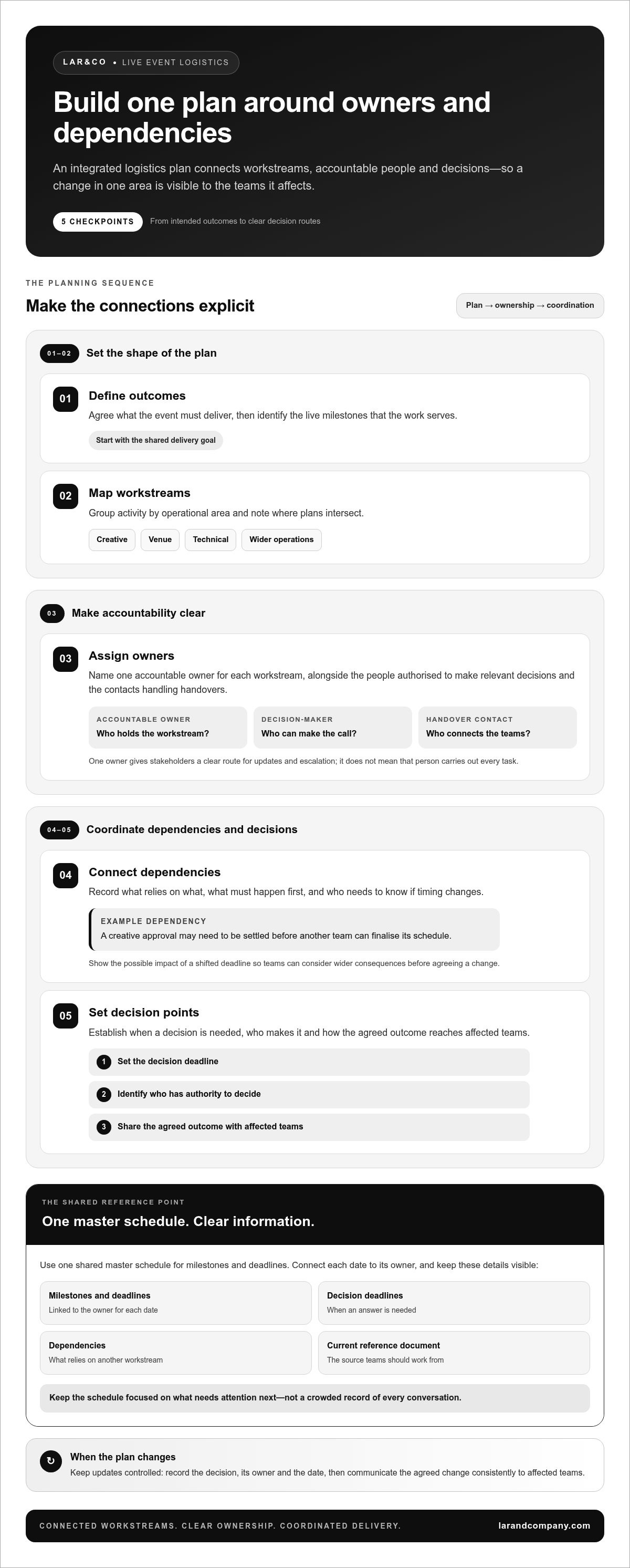
Start by grouping activity into practical workstreams, such as creative, venue, technical and wider operations—incorporating specialist partners such as Stone Security Services for event security and VIP protection. For each, record an accountable owner, the people authorised to make relevant decisions, and the handovers that connect it to other areas. Naming one accountable owner per workstream gives stakeholders a clear route for updates and escalation. It does not mean that person must carry out every task.
Next, map dependencies. For example, a creative approval may need to be settled before another team can finalise its schedule. Show what must happen first, what depends on it, and who needs to know if the timing changes. This helps teams spot sequencing pressure and consider the wider impact before agreeing to a change.
What belongs in a shared logistics control plan?
Use one shared master schedule as the reference point for milestones and deadlines. Connect each date to its owner, and show decision deadlines, dependencies and the current reference document for that work. A schedule is most useful when it clarifies what needs attention next, not when it becomes a crowded record of every conversation.
Build the plan in sequence:
Define outcomes.
Agree what the event must deliver and identify the live milestones the work serves.
Map workstreams.
Group the activity by operational area and note where plans intersect.
Assign owners.
Name one accountable owner for each workstream, alongside decision-makers and handover contacts.
Connect dependencies.
Record what relies on what, including the impact if a deadline or decision moves.
Set decision points.
Establish when decisions are needed, who makes them and how the agreed outcome reaches affected teams.
Keep updates controlled. When a plan changes, record the decision, its owner and the date, then update the shared schedule and relevant document references together. Tell connected workstream owners what has changed and what action follows. This reduces the risk of parallel versions becoming competing sources of truth. A shared plan should support discussion and action, not replace judgement or clear decision rights.
Lar&Co’s show production, technical production, site management and creative direction bring connected parts of live delivery into one production plan.
Why managing complex event logistics takes more than a checklist
A checklist can confirm that a task is complete. On its own, it can’t show whether that task unlocks another team’s work, whether the timing still supports a live milestone or who must decide when plans conflict. Software can organise information and surface updates, but people still need to interpret their impact. Tracking records activity; production control connects that activity to decisions and delivery.
Consider a routine update, such as confirming that a document has been received. It may need no wider action. A change to an agreed programme, by contrast, could affect creative, technical and operational plans at once. Treating both as identical checklist items hides the second change’s reach.
Task tracking
Records an action, its status and perhaps a due date. Useful for routine administration and clear, standalone tasks.
Dependency-led production control
Shows which workstreams rely on a decision or deliverable, who owns the next action, and how much time remains before a linked milestone is affected.
Which logistics dependencies deserve active attention?
Prioritise items with linked deliverables, immovable deadlines or several stakeholder handovers. Consider four factors: potential impact on the live outcome, timing against the next milestone, the number of connected workstreams, and the decision window still available. The tighter that window and the wider the impact, the more actively the item needs attention. Routine updates can remain in standard tracking; consequential decisions need a clear owner and route for resolution.
This is not about assigning speculative risk scores to every task. It is about distinguishing what can progress independently from what could hold up connected work. Ask: what depends on this, by when is a decision needed, and who is accountable for making it?
How do teams prevent small changes becoming show-day issues?
Make each change traceable. Record what has changed, when it was raised, the workstreams affected, the accountable owner and the next decision required. Then update the shared plan and tell the people whose work depends on it. A defined escalation route should identify who takes the issue forward and who has authority to decide, rather than leaving teams to infer responsibility from a message thread.
Technical production has interfaces with creative and operational planning, so assess changes across those connections, not in isolation. The technical production for live events perspective helps show how technical decisions relate to the wider production.
Before treating a change as closed, check its effect: are linked owners working from the same decision, and does the next milestone still have a clear path? This keeps the checklist useful while ensuring accountable judgement, not the checklist itself, directs delivery.
Coordinate event logistics from advance planning through live delivery
Coordination needs to evolve as the production moves closer to its live moments. Advance planning establishes the shared picture; readiness reviews test whether plans and decisions are aligned; live updates keep affected teams informed; closeout captures what should carry forward. Each phase has a distinct purpose, and the handover between them matters. Managing complex event logistics is continuous, not a plan that ends when teams arrive on site.
Lar&Co’s large-scale live production work spans concerts, festivals, brand experiences and cultural celebrations. Whatever the format, keep ownership, timing and current decisions connected as delivery approaches.
What should happen before teams arrive on site?
In the advance phase, bring the current plans together and check that each workstream has an accountable owner, agreed milestones and a clear route for decisions. Flag unresolved decisions explicitly. An open decision is not the same as a settled one; treating it as settled can leave connected teams working to different assumptions.
Use a readiness review to examine the links between workstreams. For each open item, establish what it affects, who owns the next action and when a decision is needed to protect the next milestone. This is not simply a status round. It gives stakeholders a shared moment to surface dependencies, resolve what they can and make ownership visible for anything that remains open. Keep the discussion focused on delivery priorities rather than detailed site procedures.
How should logistics stay aligned during and after the event?
During live delivery, communication should be brief, relevant and controlled. Share a change with the owners whose work it affects, rather than sending every update to everyone. Make the message clear: what changed, what the decision means, who owns the follow-up and whether another milestone is affected. A regular update rhythm helps teams stay oriented, while a defined route for urgent decisions ensures important information reaches the people responsible for acting on it.
Handovers need the same discipline. When responsibility moves between people or workstreams, state what has been completed, what remains open and who takes the next action. This reduces ambiguity when time and attention are focused on delivery.
Closeout should capture more than a final task status. Record significant decisions, outstanding items and lessons that can inform future productions. Separate useful learning from immediate follow-up, so unresolved actions retain an owner rather than disappearing into a general debrief. This gives teams a clearer starting point next time and helps production knowledge travel beyond the event itself.
Lar&Co’s production management connects stakeholders, timelines and deliverables from concept through completion, bringing creative intent and operational coordination together.
How Lar&Co brings complex live-event logistics into one production
Managing complex event logistics calls for more than keeping separate teams on schedule. Production oversight connects stakeholders, timelines and deliverables so creative intent can move into live delivery with clear points of coordination. Lar&Co brings show production, technical production, site management and creative direction into the wider production picture, helping each area contribute to a shared outcome.
These workstreams are distinct but interdependent. Creative direction shapes the experience; show and technical production support its delivery; site management links the plan to the event environment. Each team has its own responsibilities, yet decisions in one area may affect the timing or deliverables of another. Keeping those relationships visible helps stakeholders work from a coherent plan rather than a collection of disconnected briefs.
What does production oversight connect?
From concept through completion, production oversight aligns the people responsible for decisions with the timelines and deliverables those decisions influence. It gives stakeholders a common view of what the production is working towards, where responsibilities meet and how creative ambition relates to operational delivery. This does not replace specialist expertise. It connects the different contributions so they work together.
For an international practice, coordination also means maintaining that shared perspective across locations and project contexts. Lar&Co has primary offices in London and Los Angeles, and its work spans concerts, festivals, brand experiences and cultural celebrations. In the UK, USA, United Arab Emirates, Saudi Arabia and Qatar, production planning needs to respond to each project’s context while keeping ownership and delivery aligned.
What can Lar&Co’s documented work demonstrate?
The portfolio spans varied live-entertainment formats. It includes music projects such as Adele World and Creamfields, alongside cultural and brand work such as Expo 2025 Osaka - Cartier Women’s Pavilion. The UAE’s 50th National Day Celebration demonstrates a public-celebration context. These titles show the breadth of Lar&Co’s documented work; they are portfolio examples, not claims about specific logistics or outcomes for each production.
Explore Lar&Co’s international live-event portfolio to see the range of productions. Across different formats, the principle remains consistent: creative direction and operational delivery need to stay connected, with stakeholders able to understand how their work contributes to the whole. Production oversight creates coherence across moving parts without losing sight of the experience being made.
Lar&Co describes itself as “Producers of Live Entertainment”. For a live project that needs joined-up production thinking, discuss your project with Lar&Co.
Set the conditions for a composed live experience
Bring this framework into the earliest conversations about your production. Before timelines multiply, agree what the audience should experience and what must be true behind the scenes for that experience to happen. Identify decisions that could shape several teams’ work. Addressing those connections early gives stakeholders room to make considered choices, rather than forcing rushed compromises as delivery approaches.
Managing complex event logistics is ultimately about creating the conditions for people to do their best work together. A clear plan should leave space for informed judgement while making ownership and the route to a decision unmistakable. That balance supports a live experience that feels effortless to its audience, even when the work behind it is substantial.
Lar&Co brings production oversight to ambitious live entertainment, connecting creative intent with delivery. Discuss your live entertainment project and take the first step towards a composed, coordinated production.
Frequently Asked Questions
When should planning for complex event logistics begin?
Begin as soon as the event’s intended format and key live moments are taking shape. Early planning gives teams time to identify which decisions depend on one another before dates, creative choices or delivery commitments become difficult to adjust. For managing complex event logistics, map dependencies while options are still open, then work backwards from essential milestones. This helps stakeholders see what needs deciding, who owns it and when others need the outcome.
How do you coordinate event logistics across different time zones?
Agree decision windows that give each location a realistic opportunity to contribute, and name one owner for each decision. Record the agreed time zone alongside meeting times and deadlines to avoid ambiguity. After a discussion, share a concise written update with the decision, any action required and its owner. For teams working across the UK, USA, United Arab Emirates, Saudi Arabia or Qatar, shared written updates reduce reliance on everyone being online at the same time.
Can one logistics plan cover several event locations?
Yes. Use one overarching plan for shared objectives, milestone language, ownership conventions and reporting expectations, then maintain a distinct location plan for each venue or market. This gives leadership a coherent view across the production without assuming every location has identical needs. Link location-specific actions to shared milestones, so a local adjustment can be assessed for its effect on the wider schedule rather than remaining isolated in a separate document.
What information should a live-event logistics brief contain?
A useful brief sets out the event objectives, the outcome each major workstream supports, accountable owners, key milestones and known dependencies. Include decision-makers, handover points and the current source for detailed plans, so stakeholders know where to find authoritative information. Keep assumptions and unresolved decisions visible, with an owner and target decision date. This gives new contributors a clear orientation without turning the brief into a duplicate of every working document.
How can event teams keep logistics updates consistent?
Give each core plan a named owner and a clear version date, and establish one agreed location for the current reference documents. When a change is approved, update the relevant record and distribute a short note to the people affected. State what changed, what action follows and who owns it. Retire superseded copies where possible, so teams aren’t comparing conflicting attachments or relying on a message thread for the latest position.
What is the difference between event planning and event logistics?
Event planning shapes the overall event: its purpose, audience, format and intended experience. Event logistics coordinates the operational activity needed to deliver that design, including the timing, people, places and handovers involved. The two inform each other. For example, a change to the programme may prompt adjustments to schedules or responsibilities. Keeping planning and logistics connected helps preserve the intended experience whilst making delivery workable.
How should a team handle a change that affects several event workstreams?
First establish the change and identify which deliverables, owners and milestones it affects. The accountable lead should gather the relevant workstream input, make clear what decision is needed and route it to the person authorised to decide. Once agreed, record the outcome, update the current plans and notify affected owners with their next actions. If the decision cannot be made within the available window, escalate it through the agreed route promptly.