How to Secure Large Scale Event Permits in London
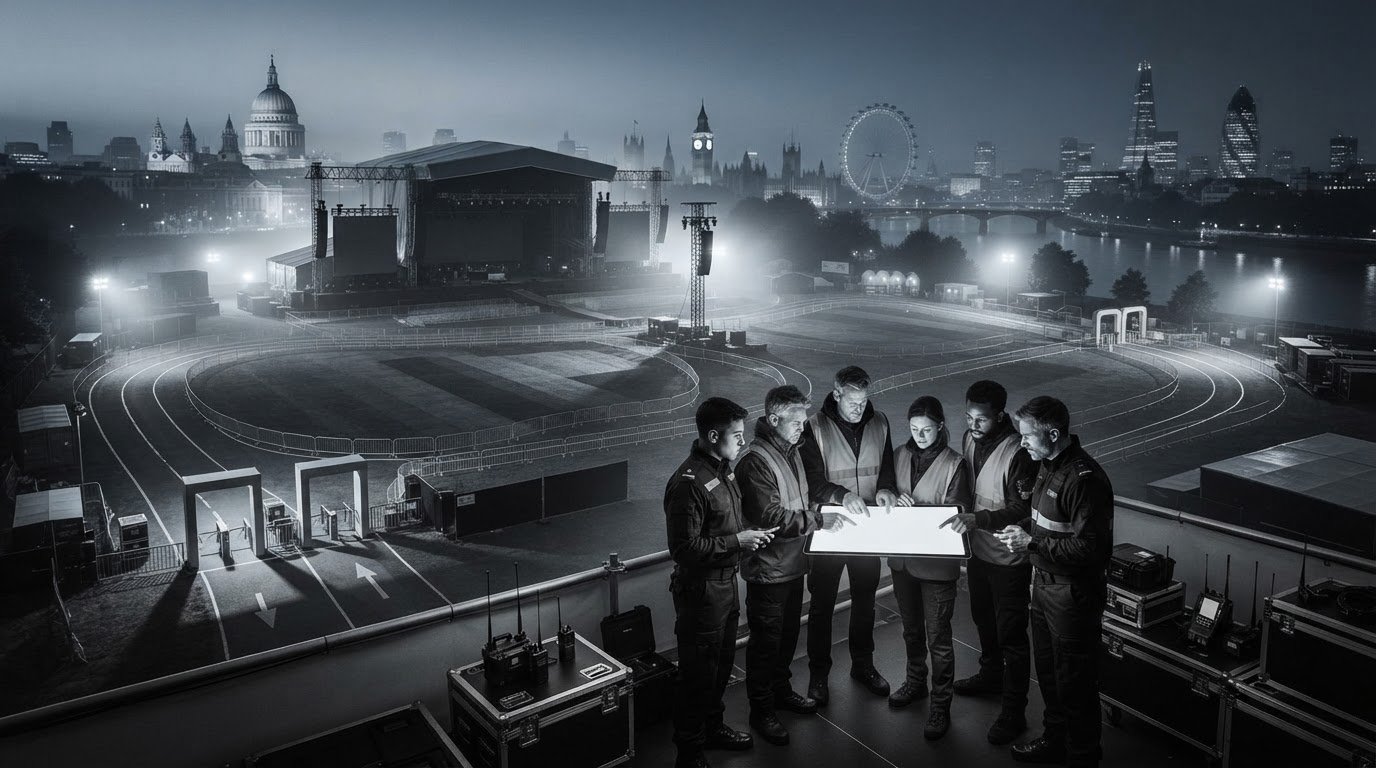
A large event is secured on paper before it is delivered on site. To understand how to secure large scale event permits in London, coordinate early with the relevant authorities and emergency services, assess site risks, and explain how people will move through the event. Bring these decisions together in one practical operating plan.
Permission is only one part of readiness. A strong plan identifies risks, sets out how teams will respond to incidents, and manages crowd movement from arrival to departure. This guide explains how to coordinate with emergency services, define incident response and plan crowd flow. Addressing the site, access points and attendee movement early helps make the overall proposal coherent.
Key Takeaways
• Bring law enforcement and emergency services into planning early, and align incident response procedures with the event’s specific risks.
• Assess how attendees will arrive, move between areas and leave, then plan barriers, signage and patrol coverage around those flows.
• Identify which London authority oversees the event location and how its requirements may shape the application.
• Match permits and licences to the event’s activities, site and operating plans before preparing an application.
• Build an application timetable around the event’s scale, risk profile and the requirements of the relevant authorities.
1. Coordination with law enforcement and emergency services
Identify the lead organiser and those responsible for safety decisions. Map the site, entrances, exits, control points and emergency access routes, then share the plan early with the relevant local authority, police and emergency services. A stage near an entrance, for example, can affect how responders access the site.
Build an incident response plan around credible threats and site conditions. CISA advises event organisers to connect with local authorities, train staff, report concerns to emergency authorities and prepare response plans. Use those steps to define who raises an alert, who communicates with responders and how teams manage an evacuation. A joint tabletop exercise can test those roles against a vehicle threat or mass-casualty scenario.
A Temporary Event Notice applies to a qualifying temporary event within its statutory limits. A premises licence is the route for licensable activity outside those limits or intended to operate on an ongoing basis. The right route depends on the activities and whether they qualify for the temporary process, not simply on the event’s scale.
Prepare an application pack that clearly identifies the organiser, event dates, operating hours, site layout and planned activities. Include a risk assessment, crowd-management arrangements, emergency response procedures and decision-makers’ contact details. These materials help the authority assess practical issues, such as whether emergency vehicles can reach the site while attendees queue nearby.
For an event in a London park, street or public square, establish who controls the land and which authority handles the proposed activity. Define the exact footprint, access arrangements and any planned changes to roads or public spaces. A park concert, for example, needs a site plan showing stages, audience areas, entrances and emergency routes.
Address noise, alcohol, food, street trading and waste as distinct operating issues. Specify where amplified sound will come from, how alcohol will be sold or supplied, and where food traders will operate. Explain how waste will be collected and removed. Permissions depend on the activities and the site, so include each issue in the event plan.
Public-liability cover should match the event activities and site requirements. Include the policy details and cover limit in the application materials, alongside any conditions attached to the venue or land agreement. Assess cover for a seated performance, for instance, against the actual site layout and planned operations.
Incomplete plans, inconsistent site drawings and unclear responsibilities can delay an application. Emergency routes that conflict with barriers or queues can create further problems. Before submission, compare the risk assessment, site plan and operating procedures. They should describe the same event and explain how police and emergency services will coordinate with the organiser.
There is no single fee for every large-event permission in London. Costs depend on the permission sought, and separate activities can require separate applications. List each permission and its fee in the event budget rather than assuming one charge covers the whole event.
2. Crowd movement and density risks
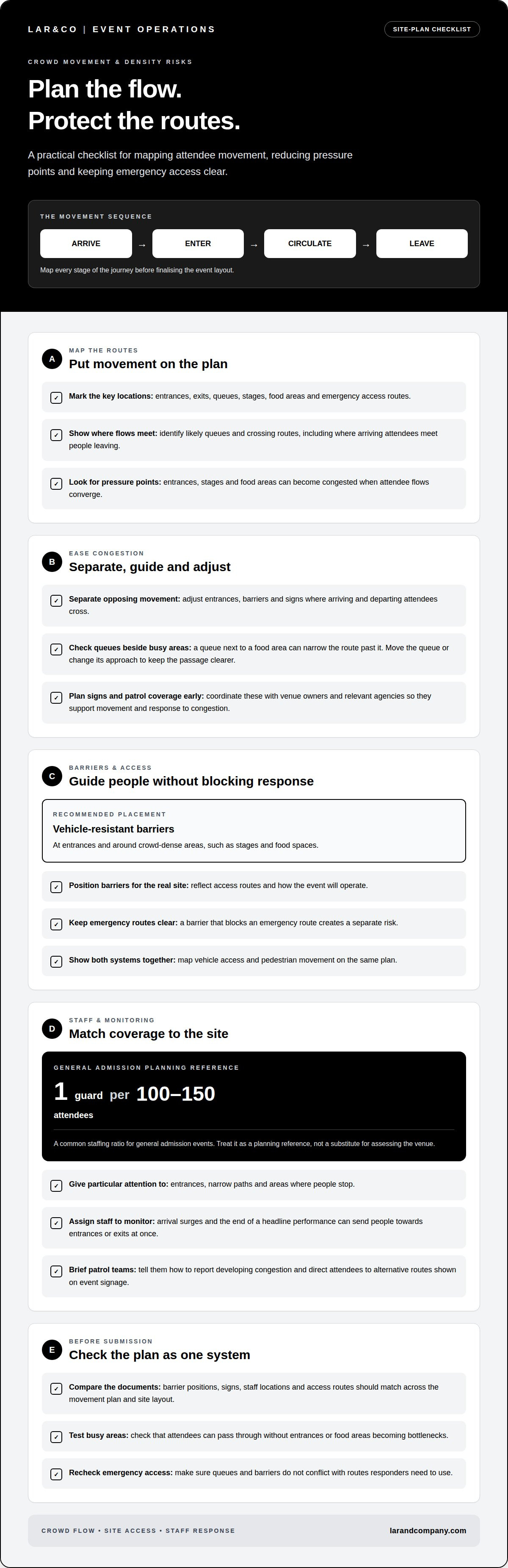
Map how people will arrive, enter, circulate and leave before finalising the event layout. A stage, food area or entrance can become a pressure point when attendee flows converge. Mark likely queues and crossing routes on the site plan, then adjust entrances, barriers and signs to separate opposing movements.
Plan barrier placement, signage and patrol coverage early with venue owners and relevant agencies. These decisions shape attendee movement and affect how staff can respond to congestion. A queue beside a food area, for example, can narrow the route past it. Moving the queue or changing its approach can keep the passage clearer.
Vehicle-resistant barriers are recommended at entrances and around crowd-dense areas such as stages and food spaces. Position them to reflect the site’s access routes and how the event will operate. A barrier that blocks an emergency route creates a separate risk, so show vehicle access and pedestrian movement together on the plan.
For general admission events, a common staffing ratio is one guard per 100-150 attendees. Treat that as a planning reference, not a substitute for assessing the venue. Entrances, narrow paths and areas where people stop may need particular attention. A stage-side food area, for instance, combines gathering, waiting and crossing movements.
Plan for changing crowd movement as well as the expected layout. Arrival surges can create queues at entrances, while the end of a headline performance can send people towards exits at once. Assign staff to monitor these areas, report developing congestion and direct attendees to alternative routes marked on event signage.
Mark
entrances, exits, queues, stages, food areas and emergency access on one plan.
Separate
crossing flows where arriving attendees meet people leaving.
Position
barriers and signs to guide movement without obstructing access.
Brief
patrol staff on congestion points and the routes they should keep clear.
Holding an event without required permissions risks enforcement action and disruption, including changes to or interruption of planned activities. Consequences depend on the permission involved and the circumstances. Treat authorisation as part of operational readiness, not as a final paperwork task.
Review the movement plan against the site layout before submission. Check that barrier positions, signs, staff locations and access routes match across the documents. In a busy public square, for example, show how attendees can pass through without turning entrances or food areas into bottlenecks.
For a busy public square, include a clear response for a vehicle moving towards a crowd. Advise people to move perpendicular to the vehicle’s path if it approaches. Briefing attendees and staff in advance makes the intended action clearer if movement becomes urgent. Keep the guidance consistent with the site’s routes and access arrangements.
Include unmanned aircraft systems, including drones, among the risks considered during event preparation. CISA’s Be Air Aware program highlights cyber and physical risks posed by unmanned aircraft systems. Its focus can inform a briefing that recognises both types of risk alongside the crowd movement issues in the site plan. Keep this awareness within operational preparation so staff understand the risks the program highlights.
3. Which London authorities issue permits for large-scale events, and how do requirements vary by borough?
Start with the event’s exact site address and identify who controls the land. A borough council may manage a park or public space, while a private venue has its own landowner or operator. The organisation responsible for the site is a key starting point, but it may not cover every planned activity.
Contact the council for the borough where the event will take place. Ask which team handles the site and event type, then describe the footprint, dates, activities and expected audience. For a park event, name the park and proposed stage location. For a street event, identify the affected road and explain how it will be used.
Separate permission to use a site from permissions related to event activities. A council’s parks or events team can explain the process for council-managed land. A licensing team may be relevant if the programme includes licensable activity, while a highways team may need to consider plans that affect roads or pedestrian routes.
These responsibilities may sit with different organisations. The borough council, landowner, venue operator and licensing authority may each have separate roles. Police and emergency services contribute to safety coordination, but their operational input is distinct from permission to use land. Record the responsible contact for each decision in the project schedule.
Requirements vary by site and event plan. A concert in a borough park may involve land-use conditions, noise controls and site reinstatement. A procession through public streets may require consideration of road access and pedestrian movement. An event at a private venue may rely on the venue’s existing permissions, alongside approvals for additional activities.
For an event crossing borough boundaries, map every site and route segment before approaching the authorities. Identify where the event starts and ends, and which roads or public spaces it uses. Then approach each relevant council about the section within its area. The route plan should make boundary changes and operational handovers clear.
Keep one permissions schedule listing the authority, contact, site or activity, requested documents and decision status. Use consistent event details across council forms, site plans and safety documents. If a borough requests a revised entrance layout, update the master plan and circulate the same version to the landowner and operational teams.
Establish local requirements through a site-specific enquiry rather than assumptions based on another borough’s event. Share a concise summary with the relevant council and land controller, including a location plan, operating outline and list of activities. Their responses can help identify the correct application routes and borough-specific conditions.
4. What licences and permits are required for a large public event in London?
There is no single permit that covers every London event. Build a permissions schedule around the site, activities and infrastructure. A concert in a park, for example, may need different approvals from a ticketed event inside a private venue. Start by separating permission to use the site from approvals for what happens there.
For each activity, record its location, operator and proposed permission route. Alcohol service, live entertainment, food sales and street trading raise distinct questions for the event plan. List a food stall in a park separately from a bar or performance stage. This makes it easier to identify which authority or land manager needs to review each element.
Check whether each proposed activity falls within an existing permission or needs a separate application. Existing venue arrangements may cover some activities, but changes to hours, layout or use can affect what needs review. For an event in a public square, compare the programme with the site’s usual use and clearly note any additional activity.
Include the physical setup in the permissions review. Temporary stages, structures, generators, fencing and vehicle access can affect the site plan and operating arrangements. Show each item in its planned position alongside public routes and emergency access. A generator beside a service entrance, for example, may change how that access point can be used.
Land
identify the owner or manager and secure permission for the event footprint.
Programme
list performances, alcohol service, food sales and trading activity.
Public space
flag road use, street closures or changes to pedestrian access.
Site setup
document stages, temporary structures, barriers and vehicle movements.
Operations
include noise controls, waste arrangements and reinstatement plans.
Use the same event description in every application. Keep the event name, dates, operating hours, site boundaries and activity list consistent. If a stage moves or a food trader is added, update the relevant plans and permissions schedule. A mismatch between a form and site drawing can leave reviewers assessing different versions of the event.
Assign an owner and status to each permission in the schedule. Record the responsible organisation, documents submitted, outstanding decisions and any conditions received. This gives the organising team a clear view of dependencies. A revised site boundary, for example, may affect both the land-use application and the event operations plan.
Review the complete schedule against the final event design before committing to delivery. Required permissions depend on the location and planned activities, so start with a precise description of both. This allows the relevant organisations to assess the actual event rather than a generic proposal.
Treat alcohol service, food sales and street trading as separate activities in the permissions schedule. Check whether each is covered by an existing permission or needs a separate application. Include noise controls, waste arrangements and site reinstatement in the operations review.
5. How far in advance should event organisers apply for London permits and licences?
Start planning as soon as the site and event concept are defined. Understanding how to secure large scale event permits in London starts with identifying the organisations involved and the decisions they need to make. A park concert, street procession and private-venue performance can follow different processes. Set the event date against the requirements for its location and planned activities.
Build a permissions timetable before the programme and site design are finalised. List the landowner or site manager, relevant borough council teams and any licensing authority connected with planned activities. For a council park event, account for the land-use process alongside approvals related to the programme. This map shows which applications can proceed in parallel.
Ask each relevant authority about its process and required materials. Make the enquiry specific: name the location, describe the event, state its activities and give the proposed operating dates. For a public-square concert, explain whether it includes amplified music, food stalls or road impacts. Clear details help establish the appropriate application route.
Work backwards from the event date once the process is clear. Allow time to prepare submissions, answer questions and revise documents. A change to the site boundary may affect the land plan, access arrangements and operating documents. Make time for those linked revisions instead of treating submission as the last planning step.
Define
record the site, event dates, operating hours and activities.
Identify
list each authority, land manager and permission route.
Sequence
note decisions that depend on site or programme details.
Prepare
assemble consistent plans and supporting documents.
Track
record submissions, questions, revisions and decisions.
Maintain one master timetable and name an owner for every application. Record its status, next action and dependencies. If a borough requests a revised layout, assign the update and circulate the same version to everyone using the plan. For organisers working out how to secure large scale event permits in London, this central record helps keep application documents aligned.
Set internal deadlines ahead of each submission. Complete documents that other applications depend on first, such as the site layout and operating outline. If the performance area or entrance changes, revise the related documents together. Consistent details make questions easier to answer and help prevent conflicting plans reaching reviewers.
Revisit the timetable whenever the event changes. A new trader, altered programme or revised road footprint can affect the permissions map. Treat each change as a prompt to review relevant applications and update the organisations involved. This keeps the approval process aligned with the developing event.
Lar&Co: Show Production
Lar&Co brings Show Production and Technical Production together with the practical demands of a large-scale live event. Turn to the team when the programme, site layout and production plan need to work as one. Site Management supports event operations, while Creative Direction shapes the experience around real-world constraints.
These capabilities help organisers coordinate production decisions with site logistics and event delivery. They complement the authority-led application process by translating the event concept into an executable production plan.
For a considered conversation about your event, contact Lar&Co.
Turn the plan into a deliverable event
The next step is to turn the permit plan into a working production brief. Define the event footprint, programme, operating assumptions and decision owners, then keep them aligned as planning advances. Give the team one current version of the plan, with clear responsibility for recording and communicating changes. This creates a shared basis for decisions as the event develops.
For organisers considering how to secure large-scale event permits in London, the practical test is whether the production plan and event operations stay coordinated. Production choices shape site requirements, while site constraints influence delivery. Lar&Co brings Show Production, Technical Production and Site Management to that work, helping shape delivery around the event’s needs.
Bring your event concept and delivery priorities into a focused conversation. Contact Lar&Co about your event and take the next step towards a considered, well-coordinated live experience.
Frequently Asked Questions
What safety, crowd-management, and emergency-planning rules apply to large London events?
Set out event-specific safety and emergency arrangements that reflect the site layout and audience movement. CISA advises organisers to coordinate with local authorities, prepare incident response plans, train staff and report concerns to emergency authorities. For example, brief stewards on communicating a blocked exit, directing attendees to an alternative route and escalating urgent concerns to the event control team.
What insurance and public-liability cover do London authorities require for event organisers?
Public-liability cover should match the event’s activities and site requirements. Include the policy details and cover limit in the application materials, alongside any conditions attached to the venue or land agreement.