How to handle difficult stakeholders with listening and trust

Managing difficult artists and stakeholders starts with listening carefully, understanding what matters to each person and agreeing how decisions will be made. Respect and trust help people raise concerns early, while clear expectations and healthy boundaries keep the work moving. The aim isn’t to win an argument. It’s to find a workable way forward.
When pressure is high, a forceful response can seem like the quickest way to regain control. But taking time to understand someone’s behaviour and underlying concerns can reveal what needs to change and where a shared decision is possible. Listening doesn’t mean accepting every demand; it means responding with clarity rather than assumptions.
This article explains how to build trust, make expectations explicit and adapt communication to different stakeholders. You’ll also learn how to involve people in decisions, address conflict directly and set boundaries when respectful discussion isn’t enough. These practical approaches can turn difficult working relationships into clearer, more productive collaboration.
Key Takeaways
• Map stakeholders by their influence and interest, then shape updates around what each person needs to know.
• Make expectations concrete by recording scope, deliverables, timelines and what sits outside the project.
• Look beneath difficult behaviour for competing priorities, uncertainty or concerns that have not yet been heard.
• Set clear, respectful boundaries when unproductive behaviour continues, while keeping the discussion focused on progress.
• Agree who is responsible, accountable, consulted and informed so decisions and follow-up remain clear.
1. How do I deal with difficult Stakeholders?
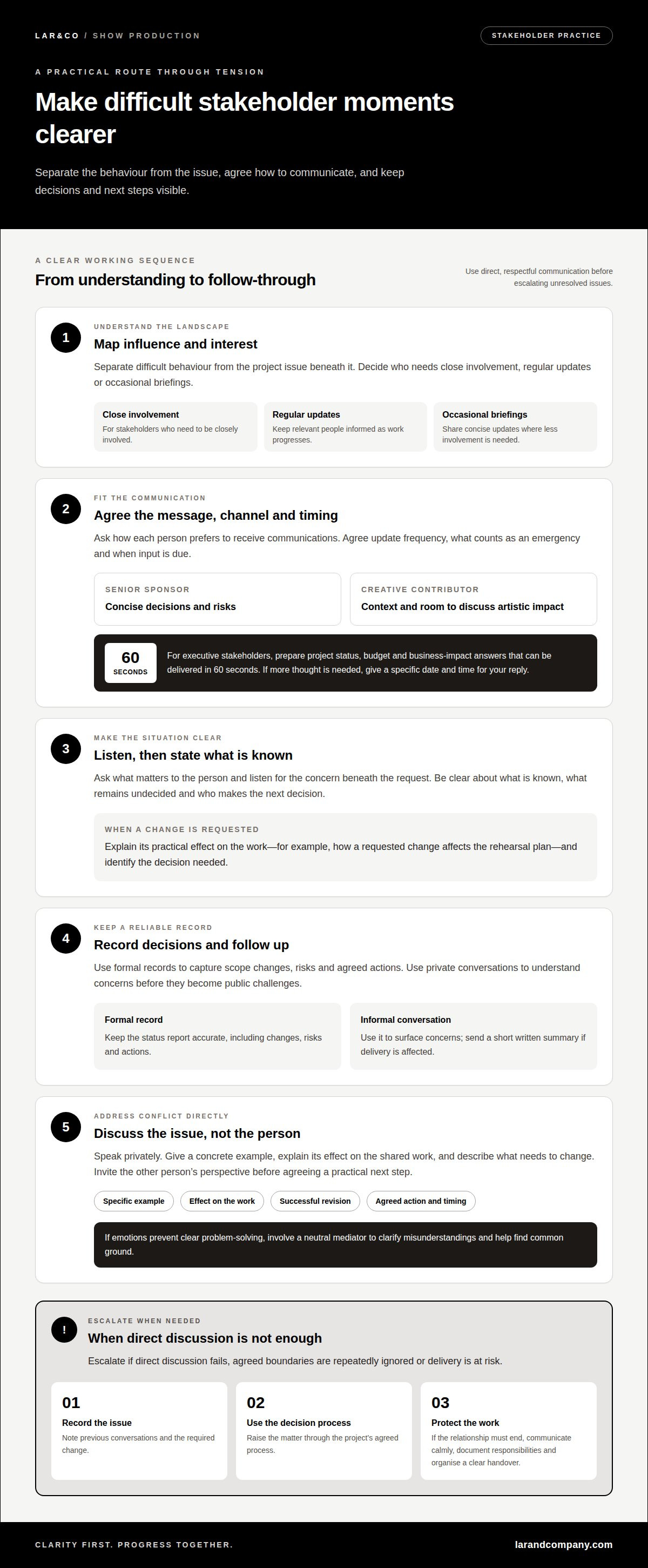
Start by separating difficult behaviour from the project issue beneath it. Map stakeholders by their influence and interest, then decide who needs close involvement, regular updates or occasional briefings. A senior sponsor may need concise decisions and risks, while a creative contributor may need context and room to discuss artistic impact. The same update rarely serves both equally well.
Tailor the message, channel and timing to the person receiving it. Ask stakeholders how they prefer to receive communications, then agree how often updates arrive, what counts as an emergency and when input is due. For executive stakeholders, prepare project status, budget and business-impact answers that can be delivered in 60 seconds. If a detailed response needs thought, give a specific date and time for your reply.
Use formal channels to record decisions and informal conversations to understand how information is moving. A written status report can capture scope changes, risks and agreed actions; a private conversation can reveal a concern before it becomes a public challenge. Both matter. Keep the formal record accurate, and follow up informal discussions with a short written summary when they affect delivery.
Transparency protects working relationships. State what is known, what remains undecided and who will make the next decision. Don’t omit inconvenient information or bury it in unnecessary detail. If a requested change affects the rehearsal plan, for example, explain the practical consequence and the decision needed. Clear facts give artists and stakeholders a chance to respond constructively.
To manage conflict with artists while preserving the working relationship, speak privately and address the specific issue rather than attacking someone’s character. Listen to the artist’s concern, explain its impact on the shared work and agree on a practical next step. Keep the discussion focused on progress, not on winning.
When giving feedback to a defensive or demanding artist, use a concrete example and describe its effect. Separate the work from the person: explain what needs to change, why it matters and what a successful revision would look like. Invite their perspective before agreeing on the action and timing.
Creative teams can resolve conflict through early, direct discussion and principled negotiation. Identify the interests behind each position, then explore options that protect both the essential creative aim and the project’s needs. If emotions prevent clear problem-solving, involve a neutral mediator to clarify misunderstandings and help the parties find common ground.
Escalate when direct discussion fails, agreed boundaries are repeatedly ignored or delivery is at risk. Record the issue, previous conversations and required change, then raise it through the project’s decision-making process. If the relationship must end, communicate the decision calmly, document responsibilities and organise a clear handover to protect the work.
2. Listening to stakeholders and understanding their expectations
Before agreeing on a plan, ask each stakeholder what a successful outcome means to them. Listen for the difference between a stated request and the need behind it. An artist asking for another rehearsal may be concerned about a transition, while a producer may be protecting the running order. Reflect the concern back in plain language, then ask what evidence would address it. This makes expectations visible before they become competing assumptions.
Define the project’s scope early and in writing. Record the agreed deliverables, key timelines, decision-makers and what falls outside the work. In community arts and heritage projects, such as those coordinated by Communities Together, clearly setting out which cultural or performance elements are fixed helps balance creative development with community expectations. Ask stakeholders to review the document and confirm their agreement in writing. A clear baseline gives the team something specific to revisit when a new request changes the plan.
Competing priorities need a shared basis for comparison. Ask each stakeholder to identify the outcome they consider essential, why it matters and what flexibility they can offer. Then compare those interests with the agreed project aims, practical dependencies and deadlines. If an artist prioritises a new staging idea while the venue needs a confirmed layout, identify which decisions depend on that layout. Agree on the sequence before debating preferences.
Document agreements, feedback and decisions in a central record. After a discussion, capture the decision, its owner, any actions and their due dates. For creative feedback, distinguish a required change from an optional suggestion, and note the reason for each. Send the summary to the people involved and invite corrections. This prevents later disagreement about what was discussed or who accepted responsibility.
Accommodating every difficult request can weaken a project. Repeated concessions may blur the original scope, shift pressure onto other contributors and make agreed boundaries seem optional. Before accepting a change, explain its effect on existing commitments and ask which priority should move. A decision is more sustainable when stakeholders understand the trade-offs, rather than assuming every request can be added without consequence.
Set expectations before work gathers momentum. At the project launch, clarify how feedback will be gathered, who can approve changes and how unresolved points will be handled. For example, if a creative revision affects a scheduled handover, explain that its impact will be assessed before the team commits. Early clarity supports collaboration without closing down discussion. It also gives stakeholders a fair chance to raise concerns while there’s still room to act on them.
Revisit expectations when the project changes. A new creative direction, revised deliverable or emerging dependency can alter what people need from one another. Ask what has changed, update the written agreement and explain the consequences to affected stakeholders. Treat the record as a working reference, not a formality. This keeps decisions connected to current commitments and helps the team address misunderstandings before they disrupt delivery.
3. Beginning stakeholder relationships with respect and trust
Set a respectful tone at the first project meeting. Introduce each person’s role, explain how their contribution connects to the work and make room for their perspective. An artist may need confidence that their creative intent will be heard; an executive may want clarity about accountability. Acknowledging both concerns shows that respect is practical, not ceremonial. It gives people a reason to engage openly from the outset.
Build trust through small, consistent actions. If you promise to send a revised schedule after a discussion, send it when agreed. If you don’t yet have an answer, explain what you’re doing to resolve the issue and when you’ll follow up. These moments of follow-through demonstrate reliability. They also make it easier for stakeholders to share concerns before those concerns harden into conflict.
Ask questions that invite useful insight rather than demand agreement. Try, “What part of this plan concerns you most?” Then listen without interrupting, summarise what you heard and ask whether you understood correctly. An artist’s objection to a cue, for example, may reflect concern about pacing, not unwillingness to collaborate. Clarifying the underlying issue helps you respond to the real problem.
Show kindness and compassion without surrendering healthy boundaries. Acknowledge pressure or disappointment, then return to the agreed behaviour and project needs. If a stakeholder speaks over colleagues in a meeting, address it calmly: “I want to hear your concern, and I also need everyone to have room to contribute.” This treats the person with dignity while making the boundary unmistakable.
Trust also depends on consistency across the team. Give stakeholders the same account of a decision, and correct misunderstandings directly rather than letting rumours grow. If an artist hears an outdated version of the rehearsal plan, share the current decision and explain what changed. Clear, consistent information reduces the risk that people interpret silence as exclusion or a breach of trust.
When tension appears, choose a private conversation before making the issue public. Describe the observable behaviour, its effect on the work and the change you need. Then ask for the other person’s view and agree how you’ll work together next. A calm, specific conversation can preserve respect while addressing the issue. If the behaviour continues, restate the boundary and follow the project’s agreed escalation process.
You can show kindness and compassion while setting healthy boundaries. Acknowledging someone’s feelings doesn’t require accepting conduct that harms the work or silences others. Focus on what happened and what needs to change, rather than judging the person’s character. Use calm, direct language, and make the boundary clear enough for everyone to understand what respectful participation requires. Where possible, pair the limit with a constructive way forward, such as inviting the person to raise the concern without interrupting. Then apply the same standard consistently. This helps preserve dignity while showing that care for a stakeholder and responsibility to the wider group are not competing obligations. A boundary is most useful when communicated respectfully and upheld reliably.
4. Identifying causes of difficult stakeholder behaviour
Start with observable actions, not labels. “Difficult” might mean an artist rejects a cue, a sponsor changes priorities or a department misses agreed handovers. Record what happened, when and how it affected the work. This separates a repeated pattern from one tense exchange and gives you something specific to discuss without making assumptions about someone’s character.
Look for practical pressures behind the behaviour. An artist challenging a production decision may be protecting the integrity of a performance; a venue representative may be concerned that a late change will affect operations. Ask what outcome they’re trying to protect and what consequence they fear. Their answer can show whether the disagreement concerns creative intent, delivery, authority or an unresolved dependency.
Unclear roles can also create friction. If two groups both believe they approve a design, each may see the other’s input as interference. Compare the decision in dispute with the agreed responsibilities and identify where ownership is ambiguous. Then clarify who recommends a change, who decides and who needs to be consulted. This addresses the source of the conflict rather than requiring the team to manage each new argument separately.
Pay attention to when the behaviour appears. If objections increase after a schedule change, a new approval stage or a change in project leadership, examine that transition. Stakeholder support can shift as the work moves from concept to delivery. Someone engaged during planning may become resistant when a decision affects their team’s role or limits their influence.
Communication patterns offer useful clues. A stakeholder who challenges decisions in a group but speaks openly in private may fear embarrassment or feel unheard in meetings. Someone who sends repeated messages may be unsure when to expect a response. Compare the setting, the people present and the information available. These details help distinguish a relationship issue from a process problem.
Test your interpretation directly and calmly. Describe the specific behaviour, explain its effect and ask what you may be missing. For example: “The revised cue wasn’t approved before rehearsal. What prevented that decision?” Listen for facts, not just explanations, and compare them with the project record. Avoid guessing at motives; a missed approval could reflect competing demands rather than deliberate obstruction.
Finally, look for patterns across individuals and groups. If several contributors raise the same concern about access to decisions, the process may need attention. If one person repeatedly disregards agreed boundaries despite clear roles and direct conversations, address that conduct separately. Identifying the cause helps you choose a proportionate response, protect working relationships and keep the project’s intended outcomes in view.
5. Involving stakeholders in decision-making
Involve people when their expertise or responsibilities can improve a decision. An artist can assess how a staging change affects performance; a technical lead can explain its effect on delivery. Define the decision needed, the available options and who has authority to approve it. This gives stakeholders a meaningful role without turning every choice into a group vote.
A RACI matrix can clarify responsibilities for each major activity. It identifies who is Responsible, Accountable, Consulted and Informed. Build the matrix collaboratively so an artist, producer and technical lead can identify gaps or duplicated authority. Review it as the project evolves, especially when a new workstream or approval stage changes who needs to contribute.
Distinguish consultation from approval. A Consulted stakeholder provides relevant input; an Accountable person makes or owns the final decision. For example, a designer may advise on visual impact while the designated decision-maker approves a change. Explain this distinction before the discussion begins. It prevents people from mistaking the chance to contribute for a promise that every preference will be adopted.
Make decisions easier by presenting options against shared criteria. For a proposed performance change, compare its creative value, effect on rehearsals and implications for other teams. Ask stakeholders which criteria matter most, then capture the trade-offs. This shifts the discussion from defending positions to evaluating choices. It also makes the reason for the final decision easier to explain.
Record the decision, its rationale, the accountable owner and any resulting actions. Include input that influenced the outcome, particularly when the chosen option differs from a stakeholder’s recommendation. A clear record helps people understand how the decision was reached and provides a reference if circumstances change. Share it with everyone affected, not only those at the discussion.
When stakeholders disagree, hear their views separately before convening a joint decision meeting. Individual conversations can surface concerns people may not raise in a group. Then bring the parties together around the decision criteria and ask which options meet the project’s essential needs. If emotions obstruct practical discussion, a neutral facilitator can help clarify misunderstandings.
Keep participation active as delivery progresses. Hold feedback sessions or use brief stakeholder surveys to ask whether project progress, communication and involvement in decisions are working. Look for specific gaps, such as a team receiving updates but lacking a way to raise concerns. Use the responses to adjust the decision process, then tell participants what changed. Closing the loop shows that their contribution has practical weight.
The RACI matrix should be shaped with stakeholder input and revisited as the project develops, keeping responsibilities aligned with changing needs. The action plan recommends conducting a stakeholder audit during week 1, helping the team identify whose perspectives and responsibilities should inform its approach from the outset. Faiza Khalil recommends documenting key discussions and decisions to support accountability in stakeholder management. Together, an early audit, a collaborative matrix and clear records provide a practical basis for participation that can be reviewed as the work progresses.
Lar&Co: Show Production
Lar&Co brings show production together with the decisions and coordination needed to deliver complex live entertainment. When stakeholder priorities affect creative direction, technical requirements or site operations, its production services provide a practical point of connection. The team works across show production, technical production, site management and creative direction, helping align distinct project needs within a clear delivery plan.
Consider Lar&Co when an ambitious live project needs experienced production leadership to connect creative intent with execution. If you’re planning a project and would like to discuss its requirements, contact Lar&Co about your project.
Carry better conversations into your next project
A difficult exchange doesn’t have to define the working relationship. The next conversation can reset its direction: name the issue, invite an honest response and agree on what progress looks like. Follow through consistently, and trust can grow through actions rather than promises.
A considered approach to managing difficult artists and stakeholders also means recognising when a conversation needs a clear decision-maker or a neutral voice. That choice can protect the work and give everyone a constructive way forward. It won’t remove every disagreement, but it can help the team handle tension purposefully and keep creative collaboration possible.
For a live project where creative ambition and delivery need to work in concert, Lar&Co can bring production expertise to the wider picture. Discuss your next project with Lar&Co, and take the next step with clarity and confidence.
Frequently Asked Questions
How do I deal with difficult stakeholders?
Deal with a difficult stakeholder by clarifying the immediate decision or action. Ask what they need resolved, what they can approve and what information is missing. If a sponsor objects to a programme change, for example, clarify whether they’re challenging the content, timing or approval process. This narrows the discussion to a manageable issue. If the decision affects other teams, explain the consequences before agreeing on a response.