Finding a production partner for global touring
A global tour can be technically ready and still stall if nobody owns permits and insurance. When finding a production partner for a global tour, assign those responsibilities in writing for every location. Don’t assume they automatically sit with the production team. The agreement should state who secures permits, who provides insurance documents and when approvals are due.
That clarity matters because a tour moves between venues, teams and local requirements, often with production decisions on tight schedules. Choose a partner whose experience, technical planning and crew coordination suit the tour’s scale and demands.
This guide explains how to assess touring experience and technical plans, survey sites for access, rigging, power and audience flow, and evaluate crew capacity across locations. It also covers how to assign responsibility for permits and insurance and define approvals before work begins, so the production plan has clear owners as well as creative ambition.
Key Takeaways
• Match a partner’s touring track record to the scale, format and technical demands of your production.
• Use venue surveys to map load-in routes, rigging points, power access and audience movement before plans are finalised.
• Separate equipment ownership from equipment coordination, and make sure the technical plan fits each venue.
• Assess how the crew will scale across locations, including who coordinates additional personnel when needs change.
• Record approval windows and ownership of permits and insurance in the production responsibilities before the tour begins.
Site surveys for access, rigging, power, and event flow
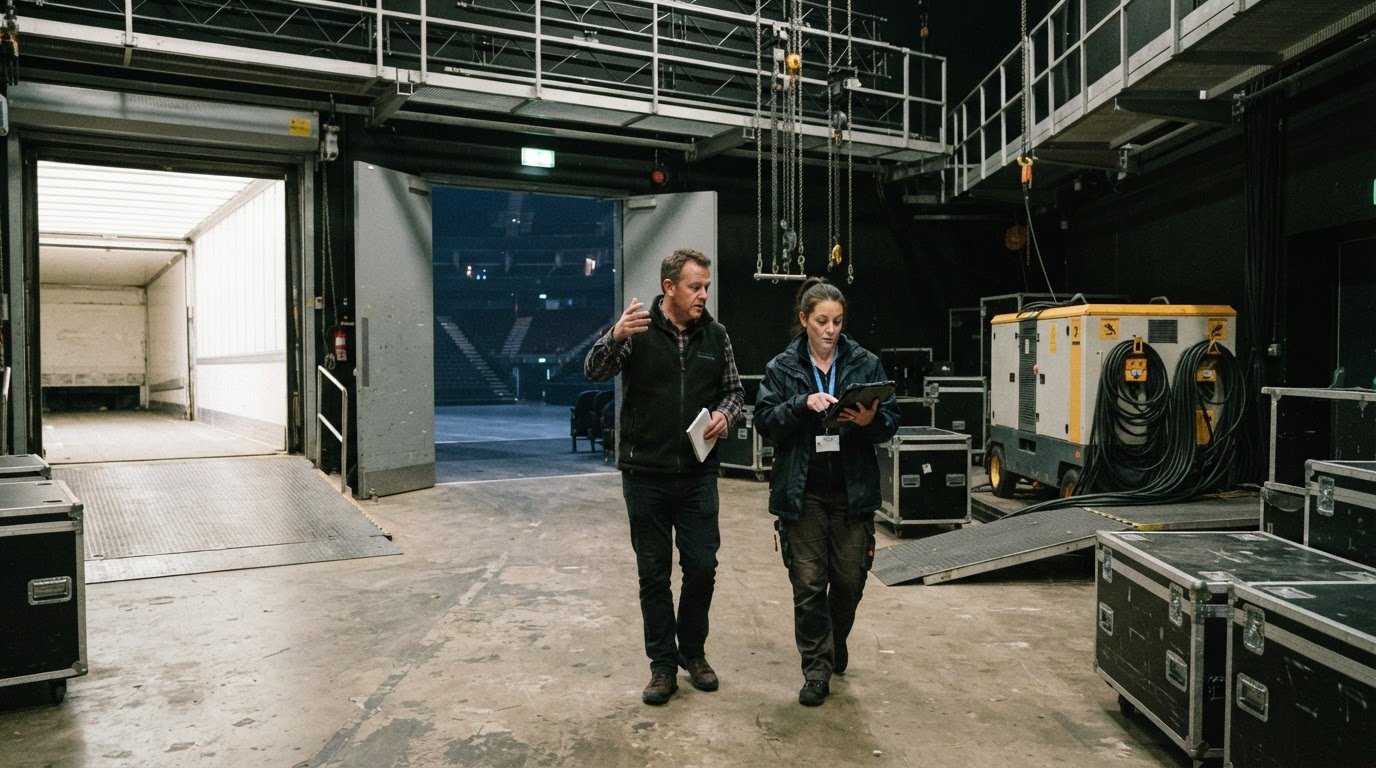
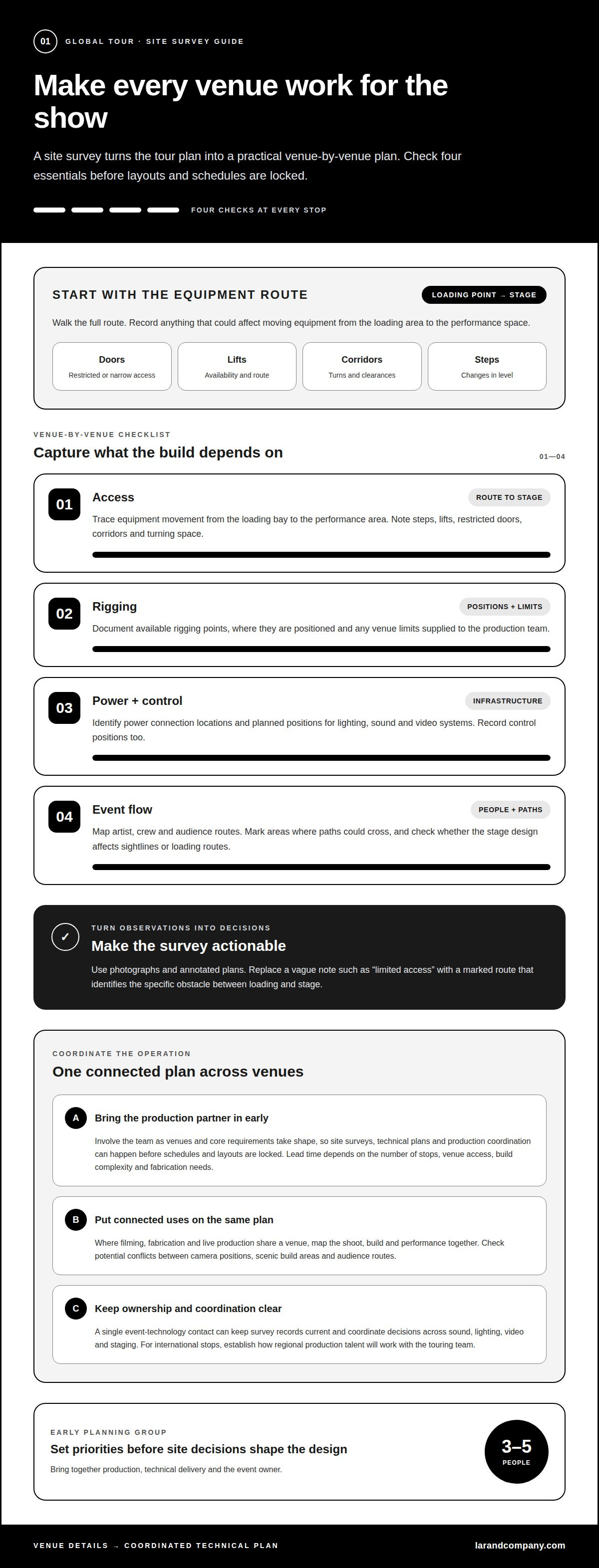
A venue survey turns a tour plan into a workable site plan. Walk the route from the loading point to the stage, noting doors, lifts, corridors and turning space. Then map rigging positions, power access, control positions and audience movement. A stage design that fits one venue may block a sightline or loading route at the next. Record constraints venue by venue rather than assuming one specification will work everywhere.
Bring a production partner in as soon as the tour’s venues and core requirements begin to take shape. The team can then survey sites, develop technical plans and coordinate production before schedules and layouts are locked. The lead time depends on the number of stops, venue access, build complexity and fabrication needs.
At each survey, capture the practical details that affect the build and show:
Access
trace equipment routes from loading bay to performance area, including steps, lifts and restricted doors.
Rigging
document available points, their positions and any venue limits supplied to the production team.
Power
identify connection locations and the planned positions of lighting, sound and video systems.
Event flow
map artist, crew and audience routes, including areas where paths could cross.
Use photographs and annotated plans to make each finding actionable. A note such as “limited access” is less useful than a marked route showing the narrow doorway between the loading area and stage. Bring a leadership group of 3-5 people into early planning, with representation from production, technical delivery and the event owner. They can settle priorities before site decisions affect the design.
When a tour combines filming with fabrication or live production, survey the spaces as one connected operation. A camera position, for example, may compete with a scenic build area or audience route. Put the shoot, build and performance requirements on the same site plan. This helps the team coordinate access, power and working areas instead of resolving conflicts separately.
A single point of contact for event technology can connect venue details with the technical plan. That person should keep survey records current and coordinate decisions across sound, lighting, video and staging. Technical plans and infrastructure must reflect the actual site, not just a standard equipment list. For international stops, establish how regional production talent will work with the touring team. Lar&Co’s Technical Production service brings site requirements into a coordinated plan, from infrastructure needs to show operation.
Production experience and owned AV inventory
A production company’s portfolio should show more than striking images. Look for work that matches your tour’s format, scale and technical demands. A stadium concert, a theatre run and a branded live experience require different production decisions. Examine case studies for evidence of planning, delivery and coordination across venues. The NBC Super Bowl LX opening film, for example, was seen by more than 125 million viewers. Large-scale credits can indicate experience under demanding conditions, but relevance to your own tour matters more than reach alone.
Assess production expertise separately from equipment ownership. A partner may own some audiovisual equipment, source other items locally or coordinate equipment supplied by another party. Each arrangement can suit a tour. What matters is a clear equipment plan for every stop, with responsibility assigned for supply, operation, transport between venues and technical compatibility.
Review the inventory against the show design, not as an impressive list. For each technical element, identify what is required, where it will come from and how it fits the production plan:
Lighting
match the planned fixtures and control approach to the creative design and venue conditions.
Audio and video
map the system requirements to the show format and each venue’s technical provision.
Supply route
distinguish partner-owned equipment from locally sourced or venue-provided equipment.
Tour continuity
record how substitutions or changes will be managed between stops.
This comparison also sharpens budget discussions without relying on a headline figure. Align each proposal with the same show scope, venue assumptions, technical responsibilities and production schedule. Then identify what could change the plan, such as a different venue configuration, additional scenic elements or a change in touring format. A lower total may reflect a narrower scope rather than a more efficient delivery plan.
Experience should account for the people involved in the production, not just the technical plan. Consider the artist’s working environment, the crew’s access to technical information and the audience’s view of the stage. For example, a lighting position may serve the show visually but restrict sightlines and diminish the guest experience. Assess technical choices for their impact on both teams and attendees.
Finding a production partner for a global tour means testing whether expertise, inventory and delivery arrangements align across locations. A strong portfolio shows relevant execution; a usable inventory plan shows how the design can be realised at each stop. Reviewing live production projects can help clarify the range of work and formats involved.
Choosing an outsourced production vendor
Outsourcing can bring production expertise and consistent delivery across cities and venues. The risk is a mismatch between the event’s demands and the provider’s capabilities. A team suited to a conference may not have the experience or structure for a touring concert or festival. Start with the event format, locations, schedule and responsibilities required. If any change during the search, revise the selection criteria to match the new brief.
Use broad criteria to create a shortlist, then compare candidates against the same requirements. Relevant experience matters, as do location, specialist knowledge, partnerships and the proposed working model. Case studies can show the types of projects a production company has delivered. Reviews, professional networks and client references offer other perspectives. Relate each example to your event’s scale and format rather than treating one project as proof of overall suitability.
Compare proposals against a consistent scope. Separate creative and technical requirements from delivery responsibilities, timeline and budget assumptions, then note where proposals differ. One may include venue coordination, for example, while another may assume the event team will handle it. A clear comparison reveals gaps before appointment and reduces the risk of later disagreement over who owns each task.
Communication during selection offers a practical indication of how the working relationship may function. Note whether responses address the brief, explain decisions and identify dependencies. Consider team compatibility too: production teams and event stakeholders work closely during planning and delivery. Misaligned decision-making or communication can slow approvals when schedules tighten. Define the main point of contact and agree how changes will be documented.
Give billing arrangements and production models the same scrutiny. Agree the scope, payment schedule and approval points in writing. Avoid leaving the full account to be settled only after the event, when unexpected expenses can push spending beyond the plan. For US production, establish whether the work is union or non-union before booking. This distinction can affect the production approach and should be resolved before plans are committed.
In-house production at a venue can suit simple presentations, small events and meeting rooms. It may be less suited to a complex tour that needs coordinated technical delivery across multiple venues. Outsourced production can bring greater consistency between locations, but only when responsibilities, communication and delivery expectations are explicit. The central risk is not outsourcing itself. It is entering the arrangement with unclear scope, unsuitable experience or unresolved decisions.
Assessing crew capacity
A touring crew must cover every phase of delivery, from planning and build to show operation and strike. Assess whether the production partner can coordinate the people needed for the schedule, locations and technical demands. A concert with broadcast elements, for example, may need specialist engineers alongside stage and production teams. Establish who sources additional freelancers if the core crew cannot cover a stop, and how they will join the existing team.
Assess the staffing plan by role, not overall headcount. Production leadership, technical direction, lighting, audio, video, staging and on-site operations each have distinct demands. The crew plan should show who leads each area, where local personnel are integrated and which roles travel between venues. This makes gaps easier to spot before they affect the schedule.
For an international tour, staffing also involves regional availability, local working practices and compliance. The plan must account for differences between markets rather than assume the same crew model works everywhere. Vetting can include experience screening for live environments, certification checks and right-to-work validation. These checks help match each person’s background to their role and location.
Specialist technical positions can be challenging to fill, especially on short-notice contracts. Technical directors, lighting programmers, broadcast engineers, RF engineers and experienced riggers are examples of roles where relevant experience matters. Match each position to the event timeline and technical requirements. If a schedule change, staff dropout or event expansion creates a gap, an active network of production professionals can help with mobilisation.
Use a location-by-location staffing matrix to make the plan practical. For each stop, record the role, responsibility, place in the schedule and whether the position is touring or locally sourced. Compare the plan with build, rehearsal, performance and strike demands. If one person has overlapping duties, or a specialist arrives only after their work is needed, adjust the schedule or crew allocation.
Finally, clarify who directs local freelancers and how they receive current production information. A lighting programmer arriving at a venue needs the relevant show documents and a clear reporting line. The same applies to audio, broadcast and staging teams. A named lead for each department keeps communication direct and helps the touring crew work effectively with local personnel.
Defining production partner responsibilities
A tour agreement should assign an owner to every production decision, document and deadline. Use a responsibility schedule covering the promoter, production partner, venue and local suppliers. For each task, record who leads, who approves and who receives updates. This prevents gaps where the touring team and venue each assume the other is arranging a critical service.
Coordinate freight, customs and local vendors clearly in every country. The schedule should identify who manages freight movements, handles customs documentation and liaises with local suppliers at each destination. The production partner can coordinate timelines and handovers with relevant specialists, while the agreement makes each party’s responsibilities explicit. Don’t assume one process applies in every country.
Define equipment responsibilities just as precisely. State whether the production partner supplies audiovisual equipment or manages its rental, and identify equipment supplied by a venue or local vendor. If a venue provides a sound system, for example, name who coordinates its integration with the touring setup. Record who approves substitutions and how changes are communicated to the technical team.
Assign a named owner and document deadline for permits and insurance. For a US shoot, the production studio usually handles permits and insurance. The agency should obtain the permit and certificate of insurance before the shoot day. For tour stops elsewhere, the written plan should assign local responsibilities instead of assuming the US arrangement applies unchanged.
Approvals can be difficult when teams work across time zones. Agree in advance who signs off on the set and establish a daily approval window that works for everyone involved. The schedule should identify the decision-maker, the materials requiring approval and how decisions will be recorded. A marked scenic plan, for instance, can show exactly which version has been approved.
Put financial and usage terms in writing alongside production responsibilities. Record the bid, payment schedule and usage rights, including footage ownership and how long the client can use it. These terms matter when production includes filming as well as a live event. A responsibility matrix can keep them visible alongside venue, vendor and technical tasks.
Before finalising the tour plan, review every location against the same responsibility schedule. Check that each task has a named owner, decision-maker and deadline. This clarifies handovers and exposes unassigned work while there is still time to organise it. Discuss production responsibilities for your tour.
Lar&Co
Lar&Co brings these production decisions into a coordinated plan. For a tour spanning venues and countries, its Show Production, Technical Production, Site Management and Creative Direction connect creative intent with practical delivery. These services suit projects that need coordinated technical planning, site management and on-the-ground execution across complex live entertainment.
Bring the tour schedule, venue plans and key production requirements to the conversation. These details help shape a clear view of the decisions and responsibilities involved. Contact Lar&Co to discuss your tour.
Set the tour in motion
Before production planning advances, turn the tour’s ambition into a concise decision brief. Set out the creative priorities, key stakeholders and decisions to make first. This gives the team a shared reference as the schedule develops and new venues or requirements emerge.
Finding a production partner for a global tour is ultimately about choosing a working relationship that can carry your priorities through delivery. Start with a focused conversation about the tour’s scale, creative direction and practical production demands. This can establish where planning should begin and how the work should be structured.
Lar&Co brings together the production oversight and on-site coordination needed to translate a live concept into a considered plan. Start a conversation with Lar&Co about your tour and give the project a clear route from ambition to execution.
Frequently Asked Questions
Who pulls the permits and insurance?
The production agreement should assign responsibility for permits and insurance at every location. For a US shoot, the production studio usually handles both, and the agency should receive the permit and certificate of insurance before the shoot day. A tour may involve different arrangements at different stops, so specify who obtains each document, who approves it and when it must be ready.
What does a global tour production partner provide?
A production partner can coordinate the planning and delivery needed to bring a live show to its venues. The scope may include show planning, technical direction, site management and creative development. For example, the partner can align production design with venue plans and show requirements. Equipment supply is a separate responsibility, so establish whether it is supplied, sourced locally or provided by venues.
How do I find and vet international tour production companies?
Start with companies whose portfolios include projects relevant to your format, scale and locations. Compare case studies, seek client references and draw on professional relationships to understand how each team works. Assess communication during selection: clear responses to a detailed brief make coordination easier to evaluate. For an international tour, consider how the proposed team will work across locations and with local suppliers.
What qualifications and experience should a tour production partner have?
Look for experience that matches the tour’s format, technical demands and operating environment. A partner with concert-tour experience may understand different pressures from one focused on conferences or brand events. Review the responsibilities held in comparable projects, including planning, technical delivery and site coordination. Then assess the proposed team’s expertise, leadership structure and approach to working with local crews at each stop.
How much does global tour production and logistics cost?
The price depends on the project and is provided after a quote request. Key cost factors include the tour’s scale, number and type of locations, production design, technical requirements, schedule and staffing model. Scope matters too: a proposal covering planning and coordination differs from one with additional delivery responsibilities. Compare estimates against the same requirements so differences in scope are clear.
How do I compare tour production companies and proposals?
Compare proposals against one consistent brief, then note differences in scope, responsibilities, schedule and team structure. Check, for example, whether venue coordination or local supplier management is included or assigned elsewhere. Consider relevant experience alongside communication and decision-making. If the tour format or requirements change during selection, update the brief and compare revised proposals on the same basis.
What should a global tour production contract include?
Set out the agreed scope, deliverables, responsibilities, decision-makers, approval process and payment schedule. Include how changes are recorded and approved, and identify ownership and usage rights for filmed material. For a tour across several venues, attach a location-by-location schedule of assigned tasks and deadlines. Clear terms help everyone understand their role before planning and delivery begin.
What permits, visas, insurance, and tax rules affect international tours?
Requirements depend on the countries visited, the work being performed and the people and equipment involved. For tours involving the UK, USA, United Arab Emirates, Saudi Arabia or Qatar, map permits, visas, insurance and tax considerations separately for each destination. Assign an owner to coordinate each item with relevant local specialists, and record required documents and decision dates in the tour plan.