Event budget optimisation: how to maximise impact without losing control
A smaller budget doesn’t have to mean a smaller experience. The sharper question is where each pound can make the greatest difference. Event budget optimization is not about cutting every line equally. It is about protecting the elements that deliver the event’s purpose while making deliberate trade-offs elsewhere.
When creative, technical and operational priorities compete, it can be difficult to know which reductions will have the least effect. Changes to budgets and supplier commitments can also make financial exposure harder to track. A clear framework helps you prioritise spend against defined outcomes, identify risks early and retain oversight from planning through final reconciliation.
That means connecting financial management with creative direction, technical production and site management, rather than treating the budget as a separate exercise. This guide explains how to set priorities, assess trade-offs, manage contingency and keep decisions visible as plans evolve. The aim is control without compromise: a production budget that supports the audience experience and the outcomes that matter.
Key Takeaways
• Set event outcomes first, then organise the budget around the workstreams and dependencies needed to deliver them.
• Use event budget optimization to weigh audience impact, delivery necessity, cost exposure, flexibility and timing before making trade-offs.
• Separate committed costs, estimates and undecided items so potential exposure is visible before it becomes difficult to manage.
• Review actuals, forecasts, commitments, risks and open decisions regularly to keep the financial picture current.
• Connect financial oversight with creative, technical and site decisions so stakeholders can act on clear, timely information.
What event budget optimisation means for a live production
Event budget optimisation means aligning planned spend with the event’s intended outcomes and the resources needed to deliver them. It is not a target to spend less at any cost. A live production has connected creative, technical and operational requirements. Reducing one line in isolation can shift pressure elsewhere, disrupt delivery or weaken the audience experience.
Sound decisions start with a connected view of the plan. Define the scope, assess income assumptions, record supplier and production commitments, understand when cash will be needed, and set aside contingency for uncertainty. These factors shape what can change, when a decision must be made and what the consequences may be. Event management often includes budgeting, scheduling, and coordinating various elements to ensure a successful outcome. In live production, those elements need to work together.
How is budget optimisation different from cutting costs?
Cost cutting reduces totals. Optimisation weighs what each spend enables against its cost and risk. The right choice depends on the event’s creative intent, technical demands and audience priorities. An element that looks discretionary on a spreadsheet may be central to the atmosphere or to reliable delivery.
Illustrative example: A team could reduce decorative touches in a reception and protect the technical provision that makes a key performance visible and audible across the space. The right decision depends on the event’s objectives and delivery plan, not on which line is easiest to remove. This is the discipline behind event budget optimization: make considered trade-offs rather than apply uniform cuts.
Compare each proposed reduction with its effect on the whole production. Could it change the audience’s experience? Would it transfer cost or risk to another workstream? Is there another approach that preserves the intended result? These questions help distinguish a genuine efficiency from a saving that creates a more costly problem downstream.
Which event outcomes should guide spending decisions?
Start by asking stakeholders to state the event’s purpose and how they will recognise success. The answer might centre on audience engagement, a shared celebration, a brand experience or the delivery of a live performance. Agreeing the intended outcome gives teams a consistent basis for assessing requests, rather than relying on preference or seniority alone.
Then separate essential delivery requirements from desirable enhancements. Essentials are the elements needed to meet the agreed scope and deliver the event safely and coherently. Enhancements may add distinction or comfort, but could be adjusted if priorities or assumptions change. The distinction is specific to each production, so record the reason for classifying an item and who owns the decision.
With priorities clear, assess competing requests against the same criteria: which outcome does this support, what does delivery depend on, and what changes if it is deferred or removed? That gives the team a practical starting point for building and reviewing the budget without losing sight of the live experience.
How to build a live event budget around priorities and dependencies
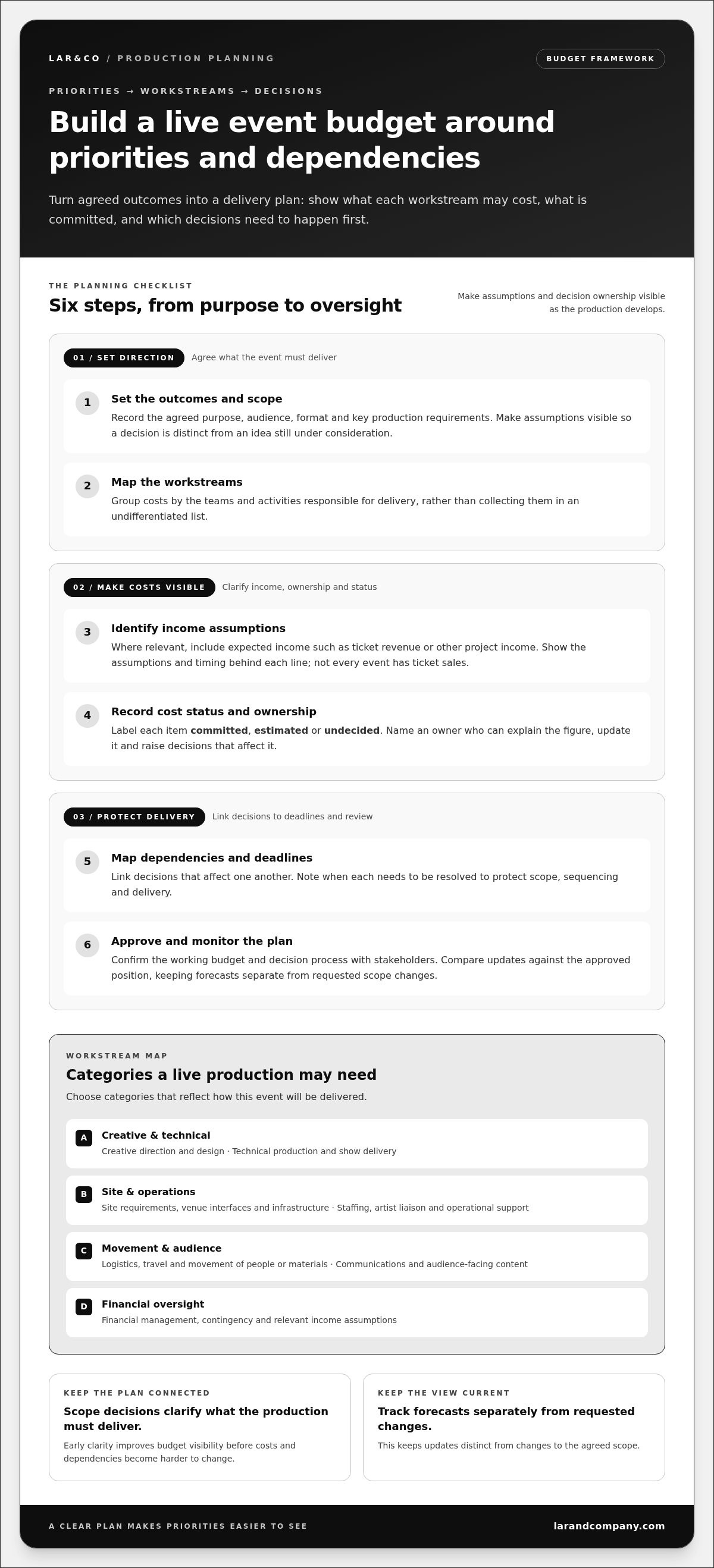
A useful budget turns agreed priorities into a delivery plan. It shows what each workstream may cost, what must be decided first, which commitments are already in place and where estimates could change. Early scope decisions improve budget visibility because they clarify what the production must deliver before costs and dependencies become harder to change.
Build the plan in sequence, then keep it current as the production develops:
Set the outcomes and scope.
Record the agreed purpose, audience, format and key production requirements. Make assumptions visible so teams can distinguish a decision from an idea still under consideration.
Map the workstreams.
Group costs by the teams and activities responsible for delivery, rather than collecting them in an undifferentiated list.
Identify income assumptions.
Include expected income where relevant, such as ticket revenue or other project income. Not every event has ticket sales, so show the assumptions and timing behind each income line.
Record cost status and ownership.
Mark each item as committed, estimated or undecided. Assign an owner who can explain the basis of the figure, update it and raise decisions that affect it.
Map dependencies and deadlines.
Link decisions that affect one another, then note when each needs to be resolved to protect scope, sequencing and delivery.
Approve and monitor the plan.
Confirm the working budget and decision process with stakeholders. Compare updates against that approved position, keeping forecasts and requested scope changes distinct.
Which budget categories should a live production map?
Use categories that reflect how the event will be delivered. Depending on its scope, a budget might include:
• Creative direction and design
• Technical production and show delivery
• Site requirements, venue interfaces and infrastructure
• Staffing, artist liaison and operational support
• Logistics, travel and movement of people or materials
• Communications and audience-facing content
• Financial management, contingency and relevant income assumptions
Give each line a named owner and a clear status. This makes it easier to trace a proposed change to the person, workstream and decision it affects.
How should teams assess estimates and dependencies?
An estimate is useful only when its basis is clear. Record what it covers, the assumptions behind it, its status, its owner and the date by which a decision is needed. Project scope and delivery requirements shape estimates, so a broad benchmark is no substitute for a considered plan.
Map dependencies across design, technical requirements, venue conditions, operations and timelines. For example, a change to the event layout may affect technical plans, site access and the sequence of installation. Flag those connections before approving the change. Digital.gov links budgeting and performance for federal agencies through priorities and measures of progress. The same principle supports clearer decisions: connect each allocation to an objective and a way to assess progress.
For complex live productions, Lar&Co connects creative, technical, site and financial considerations through production planning and delivery.
How to assess event budget trade-offs without weakening the experience
Assess a proposed reduction by what it changes, not just by the revised total. Compare each option using the same criteria, then record its impact on connected workstreams before approval. This makes event budget optimization a structured decision, rather than a contest to find the lowest estimate.
Use a comparison table to put alternatives side by side. Rate each factor consistently, for example as low, medium or high, and add a short explanation. The ratings support discussion; they do not replace judgement about the production’s objectives.
| Factor | Question to ask |
|---|---|
| Audience impact | How might this option change what audiences see, hear, experience or take away? |
| Delivery necessity | Is it required to deliver the agreed scope or a dependable production? |
| Cost exposure | What could the decision change in the forecast, commitments or other workstreams? |
| Flexibility | Can the option be adapted or deferred without compromising the intended result? |
| Decision timing | By when must stakeholders decide, given the schedule and existing commitments? |
The lowest estimate is not automatically the strongest choice. Compare like with like: check what each alternative includes, what assumptions it depends on and whether it transfers requirements or costs to another part of the plan. A lower figure may come with a narrower scope; a higher one may include elements that reduce delivery complexity. Make those differences visible before deciding.
How can stakeholders rank proposed spend?
Assess each proposal against the event objectives and essential delivery requirements. Identify the elements that protect the central experience, then distinguish them from optional enhancements. Record the reasoning, expected consequence and decision owner for material trade-offs. A shared rationale helps stakeholders apply consistent criteria, even when creative, technical and operational priorities compete.
Illustrative example, not a Lar&Co project outcome: A production team might compare reducing decorative detail with altering a technical element that shapes a key audience moment. If the latter affects the central experience or other delivery requirements, the apparent saving may carry greater consequences. The table helps make that difference clear before a decision is made.
When can a budget change create greater risk?
Distinguish a scope change from a delivery efficiency. A scope change alters what the event will provide; an efficiency seeks a different way to deliver the same agreed requirement. Record which applies, what it affects and who has authority to approve it. That clarity protects the production plan as well as the budget.
How to track forecasts, changes and contingency throughout delivery
A budget needs regular review as plans, commitments and delivery conditions evolve. A useful live-production budget review shows what has been spent, what is committed, what the event is now expected to cost and which decisions could change that position. It gives stakeholders a clear view of exposure while there is still time to respond.
Use a repeatable cycle at agreed planning points, with more frequent reviews as deadlines or material decisions approach:
Update actuals.
Record costs incurred against the relevant workstream and note any items awaiting final information.
Refresh commitments.
Check agreed supplier and production commitments, including changes to scope or timing.
Revise estimates.
Update expected costs using the latest information, and retain the assumptions behind each material change.
Review risks and contingency.
Identify what has changed, whether contingency assumptions remain appropriate and what exposure remains.
List open decisions.
Name the decision owner, required date and likely effect of each unresolved choice.
What should a regular budget review include?
Compare the approved budget, committed spend, actuals and current forecast in one view. For material items, show the owner, update date and unresolved assumptions. Summarise variances by cause, not just by amount: a revised estimate, a timing shift and a scope change call for different responses. A concise stakeholder report should make the decisions needed, their deadlines and likely consequences easy to see.
Keep forecast changes distinct from approved scope changes. A forecast change updates the expected cost of delivering the existing plan. An approved scope change alters what the event will deliver, so it may affect the plan itself, not only the forecast. Record the reason, approval and related adjustments to keep comparisons meaningful.
How should teams manage contingency and change requests?
Contingency is planned capacity for uncertainty, not spare money to spend casually. Set out what it is intended to address, who can authorise its use and how decisions will be recorded. Revisit the assumptions as risks resolve, emerge or change; the appropriate reserve depends on the production’s specific uncertainties and commitments.
Assess every change request across its financial, schedule, scope and audience effects before approval. A request to alter a production element, for example, may also affect technical plans, site requirements or delivery sequencing. Document the impact, decision owner and any resulting forecast update. Use project-specific approval routes so teams know which decisions can be made within a workstream and which need stakeholder approval.
This discipline supports event budget optimization by turning new information into controlled decisions. It also helps distinguish a genuine change in exposure from a change in what the event is expected to deliver. Clear financial oversight connects those choices with creative, technical and operational planning.
How production financial management supports better event budget decisions
Financial oversight is most useful when it informs production decisions as they develop. Creative direction shapes the intended experience. Technical production determines how that intent is delivered. Site conditions and operational plans shape what is practical, and each can affect the others. A joined-up view helps stakeholders understand the financial implications of decisions across the production, rather than reviewing costs as isolated lines.
Transparent reporting gives decision-makers a shared view of the current position: what has been agreed, what is changing, what remains uncertain and where a choice is needed. That clarity can help teams act while options are still open. It also gives financial information a practical role in event budget optimization: supporting decisions that balance the purpose of the event with the requirements of delivery.
What does integrated budget oversight contribute?
Coordinated oversight makes dependencies easier to see. A creative adjustment may affect technical requirements; a site constraint may influence operations or scheduling. Bringing those perspectives together helps teams understand the full implications of a proposal before it moves forward. Clear accountability matters too. Each material budget line and decision needs an owner who can explain its status and raise changes through the agreed process.
That responsibility should continue from concept through completion. Early estimates and assumptions form the starting point; as commitments and actuals develop, reporting can show how the forecast relates to the approved plan. At close, final reconciliation records the financial position and supports learning for future planning. This approach brings discipline to complex productions without implying that a particular saving or financial result is assured.
For a broader view of how financial oversight fits into live entertainment, explore production financial management. The principle is consistent: financial information should connect to the decisions shaping the production, not sit apart from them.
How can production experience inform financial decisions?
Experience across different forms of live entertainment can help producers recognise where creative, technical and site decisions intersect. A concert, festival, brand experience or cultural celebration will each bring its own priorities and delivery conditions. The relevant question is not whether one production’s approach can simply be copied, but how its planning discipline can inform a different brief.
Lar&Co’s work includes live entertainment projects such as Adele World and Creamfields. These examples illustrate the range of productions in which creative ambition and delivery planning sit alongside financial oversight. They do not imply specific budget outcomes. Each project calls for decisions grounded in its own scope, dependencies and objectives.
Lar&Co provides financial management alongside production planning and delivery, bringing financial oversight into the decisions that shape a live experience.
Make the next decision with confidence
The next production decision is an opportunity to set the tone for everything that follows. Before plans gather momentum, agree how financial choices will be reviewed, who needs to be involved and what information they will need to decide. That shared discipline keeps event budget optimization connected to the production’s ambitions, rather than turning it into a late-stage exercise in compromise.
Clear oversight does not restrict creative ambition. It gives teams a firmer basis for pursuing it, with decisions made in view of their wider effects. Lar&Co brings financial management into the planning and delivery of live productions, connecting financial oversight with the work on the ground.
If you are shaping a production and want to establish the right financial approach from the outset, discuss your live production with Lar&Co.
Frequently Asked Questions
What does event budget optimisation mean?
Event budget optimization means directing available funds towards the event’s agreed purpose and delivery requirements. In practice, it helps teams judge a new request by asking what outcome it supports and what else may need to change. For example, adding an audience feature may also affect staffing or technical planning. Considering those connections helps decision-makers understand the wider implications before committing.
How do you optimise an event budget without cutting quality?
Protect the parts audiences notice most and explore alternatives for less central elements. For instance, a team might simplify printed materials whilst preserving the live interaction those materials were intended to support. Check whether a proposed adjustment changes accessibility, timing or the event’s creative intent. Quality is not a single budget line; it depends on how well the production’s elements work together for its audience.
Which costs should an event budget include?
Include costs relevant to the event’s full scope, such as venue and site requirements, creative and technical production, staffing, logistics, communications, audience services and financial oversight. Account for income assumptions separately where they apply, and note the timing of expected receipts and payments. For productions in the UK, USA, United Arab Emirates, Saudi Arabia or Qatar, build location-specific venue, supplier, currency and logistics assumptions rather than carrying figures across markets.
How can event teams track spending against the budget?
Maintain a single current record that shows the approved amount, payments made, outstanding commitments and the latest expected total. Give material entries an owner and update date, then investigate differences rather than simply changing the forecast. A shared spreadsheet or finance system can support this if teams use consistent categories and version control. Highlight decisions needed so stakeholders can see where action may affect the financial position.
What is a contingency in an event budget?
A contingency is a planned reserve for uncertainty that cannot be fully specified at the outset. Its purpose is to address relevant unforeseen needs, not to fund optional additions by default. Define what risks it is intended to cover, who can approve its use and how each drawdown will be recorded. As uncertainties resolve or new ones emerge, review whether the reserve still reflects the production’s exposure.
How should you handle an event budget overrun?
First establish what has changed and whether the variance is confirmed, forecast or linked to a requested scope change. Identify the affected commitments, delivery dates and workstreams, then present stakeholders with the available choices and their consequences. Record the decision and update the forecast promptly. Avoid concealing an overrun by moving costs between categories; clear reporting gives the team a more reliable basis for response.
How can you measure return on investment for a live event?
Choose measures that match the event’s purpose before delivery begins. Depending on its objectives, these might include attendance, audience engagement, qualified enquiries, sales activity, stakeholder feedback or longer-term customer relationships. Set a baseline where possible and decide how information will be collected, then compare results with the intended outcomes. Not every event has immediate revenue as its primary return, so interpret financial and non-financial measures in context.