Dubai Festival Management Services for Events of Every Scale

A festival’s scale depends on the plan connecting every moving part. Dubai festival management services bring event goals, audiences, venues, approvals, production and seasonal planning into one coordinated approach, so early decisions support delivery on site.
That coordination matters whether the programme is a focused cultural gathering or a large, multi-day public event. The creative concept must work alongside operational requirements, and the audience experience depends on both.
This article explains how to shape festival objectives around the people you want to reach, assess venue and production needs, coordinate approvals, and plan for Dubai’s seasonal conditions. It also outlines what end-to-end management can involve, which factors influence a project’s scope, and how to move from an initial concept to a practical delivery plan.
Key Takeaways
• Set clear event objectives and audience priorities before shaping the programme, so creative and operational decisions serve the same purpose.
• Assess venue suitability alongside access, audience flow, production requirements and the approvals relevant to the event.
• Plan festivals, exhibitions and conferences around their distinct formats, balancing programming, visitor experience and site operations.
• Build cultural relevance and seasonal conditions into the schedule, site design and production plan from the outset.
• Coordinate creative direction, production and site management as connected parts of delivery, rather than treating them as separate tasks.
Understanding event goals and target audiences
Effective Dubai festival management services begin with a defined outcome, not a production schedule. Organisers should identify the event’s purpose, intended audience and measures of success before developing the programme. A cultural festival may aim to deepen local engagement, while a corporate event may prioritise stakeholder connection. Those aims shape the format, content and operational decisions that follow.
Defining the audience takes more than a broad label. Map who the event must serve, why they would attend and what experience would bring them back. For a family festival, that could mean activities for different ages and clear visitor routes. For an industry audience, useful content and purposeful networking may matter more. Each choice affects event design, production and delivery.
The AlUla Wellness Festival provides a regional example of programming at scale: it offered more than 250 classes over three weeks and attracted more than 2,000 attendees. The figures illustrate why programme volume and audience size need to be considered together. A schedule should offer meaningful choice without making movement between activities difficult. The right balance depends on the event’s objectives and audience needs.
Turn those objectives into a working brief. Set out the audience, programme priorities, desired atmosphere, site needs and production requirements. Then align staging, sound, screens and lighting with the content. A conference presentation may need clear sightlines and intelligible speech; a live performance may rely on lighting cues and smooth transitions. Technical production should support the programme, not compete with it.
Costs follow the scope of the brief. They depend on factors such as venue requirements, programme complexity, production design, staffing and event duration. A tailored scope can distinguish essential delivery needs from optional enhancements. Financial management keeps these decisions connected, so the wider effect of changes to staging or audiovisual requirements is clear.
Online event management company listings can offer an initial view of the market, but a directory entry is not a delivery plan. Compare the work shown with your event’s format and production demands. Then assess whether the proposed design, technical planning and on-site execution form a coherent approach. For a Dubai festival, a strong brief gives every decision a clear purpose, from the first audience insight to the final programme cue.
Partner selection should follow the brief. Gulf Holdings marked its 25th anniversary when selecting an event management company. Goodfirms reviewed 77 event management companies in Dubai as of November 2026.
Armin van Buuren performed on the 149th floor of the Burj Khalifa during the UNTOLD event in Dubai, illustrating the importance of matching venue and production choices to the intended experience.
Venue sourcing, permits, and compliance
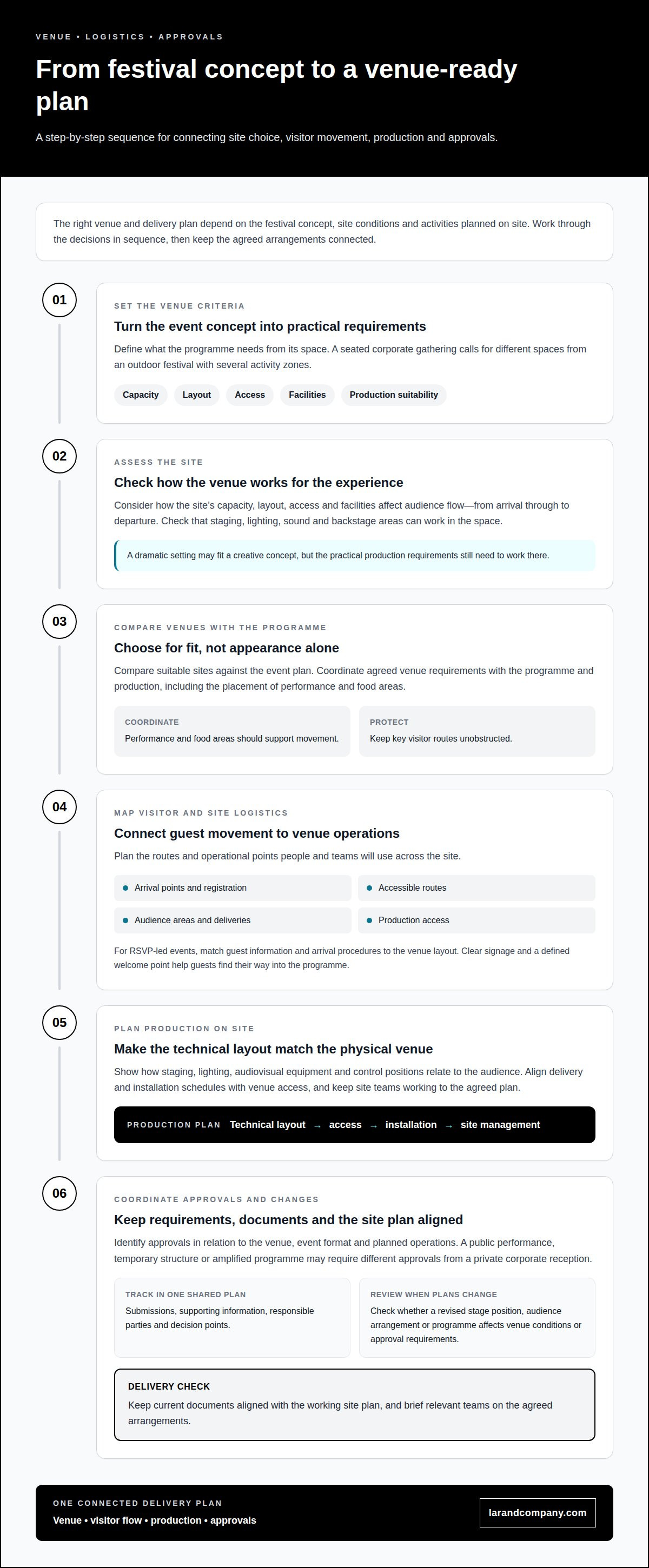
Venue, production and logistics planning can cover site selection, technical requirements, visitor movement and coordination of approvals. The scope depends on the festival concept, venue conditions and activities planned on site.
Venue sourcing and selection
Start by translating the event concept into venue criteria. A corporate gathering with a seated programme needs different spaces from an outdoor festival with several activity zones. Assess the site’s capacity, layout, access, facilities and suitability for the planned production. These factors affect audience flow and the experience from arrival to departure.
Compare suitable venues against the programme, rather than choosing on appearance alone. A dramatic setting may suit a creative concept, but staging, lighting, sound and backstage areas must also work there. Venue management coordinates agreed site requirements with the event plan. For instance, position performance and food areas to support movement without obstructing key routes.
Venue logistics management
Logistics coordination connects the venue plan to each event operation. Map arrival points, registration, accessible routes, audience areas, deliveries and production access. For an RSVP-led event, guest information and arrival procedures should match the venue layout. Clear signage and a defined welcome point help guests move from entry to the programme without confusing crossings.
Production planning must reflect the physical site. A technical layout should show how staging, lighting, audiovisual equipment and control positions relate to the audience. Delivery and installation schedules must align with venue access, while site management keeps teams working to the agreed plan. Examples of live-event production can show how these elements connect in practice.
Permits and compliance
Approval coordination starts with identifying the event activities and the site conditions involved. A public performance, temporary structure or amplified programme may require different approvals from a private corporate reception. Build a requirements schedule around the venue, event format and planned operations. Track submissions, supporting information, responsible parties and decision points in one shared plan.
Keep compliance planning connected to production changes. If the stage position, audience arrangement or programme changes, review whether the updated plan affects venue conditions or approval requirements. Keep current documents aligned with the working site plan, and brief relevant teams on agreed arrangements. This coordination helps turn the creative concept into controlled, practical execution.
Festivals, exhibitions, and conferences
Festival, exhibition and conference formats need different programme structures and production priorities. In Dubai, the format should determine how content, entertainment, audience movement and technical delivery work together.
For a public festival, organisers must coordinate stages, activations, food areas and visitor routes across the site. Abu Dhabi’s MOTN Festival welcomed more than 260,000 visitors and ran for 34 days in 2026. Its programme included 493 live performances and more than 62 food concepts. These figures show how varied programming increases the need for clear scheduling and practical coordination. Each zone needs a defined role, with transitions that help audiences move between experiences.
Exhibitions depend on a different rhythm. A successful visitor journey connects arrival, displays, demonstrations and opportunities for engagement. For example, a technology exhibition can schedule product demonstrations as activations instead of placing every feature in one static display. Production planning should give each exhibitor suitable sightlines, power access and visitor space while keeping the wider floor plan clear.
Business conferences centre on delegates’ time and the purpose of each session. A tailored programme might combine keynote presentations, panel discussions, networking and entertainment. Planners map these elements against room changes, speaker transitions and audiovisual cues. For a conference with simultaneous sessions, clear wayfinding and consistent technical standards help delegates move between rooms without losing the programme’s thread.
MICE covers meetings, incentives, conferences and exhibitions. These formats can bring business content and guest experiences together. The design needs to connect the corporate objective with each scheduled activity, from a plenary session to an evening reception. Production details matter: sound must suit spoken presentations, while lighting can change the room’s atmosphere between sessions and social moments.
Liwa Village recorded more than 224,000 visitors in 2026, illustrating the scale a destination festival can reach. At that scale, programme design must account for audience circulation, service areas and the relationship between entertainment and commercial activations. A site plan should show how visitors encounter each area, not simply where individual features sit.
Across all three formats, begin with the event’s purpose, then build a programme and production plan around it. Define the audience journey, schedule, spatial needs and technical cues before execution begins. The result is a coherent experience, whether the brief calls for a civic festival, a focused exhibition or a corporate conference shaped by a clear creative concept and shared passion.
Cultural and seasonal festival planning
A festival calendar shapes its audience, programme and production requirements. In Dubai, cultural context and seasonal conditions should inform the event concept from the earliest planning stage.
Start with the client’s vision, then consider how the timing supports the intended experience. A public cultural celebration may depend on shared traditions, while a corporate gathering may need to fit delegates’ schedules. The programme, operating hours and audience facilities should reflect that purpose. For conferences, consider how the festival schedule fits around daytime sessions and evening events.
Regional examples show how place and season can become part of an event’s identity. Layali Diriyah Nights 2023 illuminated 22,000 palm trees in Diriyah, Saudi Arabia. The setting became an active element of the experience, rather than a backdrop. For a Dubai festival, the same principle means shaping the creative concept around its location, cultural character and intended audience.
Calendar planning also means accounting for competing demands on the audience and site. Map event dates against relevant cultural occasions, public activity and venue operations. Then build a programme that gives each performance, activation and gathering enough space. A festival combining daytime family activities with evening entertainment, for example, needs transitions that work for both audiences.
Seasonal conditions influence the practical plan. Review proposed hours, indoor and outdoor spaces, audience comfort provisions and technical requirements together. A daytime programme may need a different site layout from an evening event. Plan lighting, sound and screen visibility for the chosen setting and time, rather than adding them after the programme is fixed.
Timing can also shape the production schedule. Layali 24-25 was scheduled to run from 11 February to 11 April 2025 in Diriyah, Riyadh. Its extended calendar illustrates why multi-date events need consistent operations and programming, alongside room for variation. In Dubai, a festival spanning repeated dates can benefit from clear daily schedules, defined changeovers and a coordinated plan for maintaining the audience experience.
Translate the seasonal brief into decisions the delivery team can use: dates, operating hours, audience profile, programme priorities, site conditions and technical needs. Review them together whenever the concept changes. This keeps cultural intent connected to production detail, helping the event feel distinctive and well executed, not simply scheduled.
End-to-end festival management
End-to-end festival management connects planning, creative development, production, site operations and financial oversight. In Dubai, start planning 6-12 months ahead to coordinate permits, vendors and creative talent.
End-to-end service scope
An event management company can coordinate the workstreams that turn a festival concept into a delivered event. The scope may include creative direction, show and technical production, site management, artist liaison and financial management. The key is how clearly each responsibility connects to the master plan, from programme decisions and production schedules to on-site execution.
Set one working schedule for key decisions, dependencies and approvals. For example, a brand activation may need a confirmed site position before its staging, lighting and audience route can be finalised. A central production plan makes these links visible and gives teams a shared reference when a programme element changes.
End-to-end delivery requires active coordination, not simply a collection of services. Site management connects the schedule with activity on the ground. Financial management tracks how scope decisions affect the overall plan. For an international festival, artist liaison links performance requirements with production timings. These responsibilities help maintain attention to detail across complex logistics.
Festival planning lead time
Allow 6-12 months for festival planning in Dubai. This lead time gives the team space to develop the concept, coordinate permits, secure vendors and shape the production plan. The schedule should reflect the festival’s scale, programme and venue requirements, with dependencies identified early.
Build the schedule backwards from the event dates. First map major approvals and venue decisions, then set milestones for creative development, technical planning, contracting and production. A programme change can affect several later tasks, so assign ownership and record decisions in one shared schedule. Review progress at planned checkpoints.
Early planning also supports considered financial decisions. Separate essential production and site requirements from optional enhancements, then assess changes against the agreed objectives. For example, adding a performance may affect artist coordination, stage scheduling and technical needs. A clear decision process keeps these effects visible and helps prevent late additions from disrupting delivery.
Global festivals often bring multiple teams, partners and creative disciplines together. A single operating plan can align responsibilities, logistics, production timings and brand activations. For a festival with several stages, define who owns each transition and how updates reach the wider team. End-to-end management connects decisions to support a coherent audience experience and controlled execution.
Discuss your festival management plan and its delivery requirements.
Lar&Co
Lar&Co brings festival concepts into practical delivery when creative ambition, production and site operations need to work as one. Its work spans creative direction, show and technical production, and site management, connecting the programme with the demands of live execution.
For a festival team developing an event in Dubai, Lar&Co can help align the vision, audience experience and production plan from development through delivery. Involve Lar&Co when the event’s scope calls for coordinated production expertise across multiple moving parts.
Contact Lar&Co to discuss your festival plans.
Set your festival in motion
The next step is to turn ambition into a clear working brief. Define the experience you want guests to remember, the decisions that need ownership and the priorities that will guide delivery. This gives every creative and operational choice a shared point of reference.
A considered approach to Dubai festival management services brings the event vision into practical focus. Lar&Co’s show production, technical production and site management connect the live programme, technical delivery and on-site activity. These disciplines work together around the event’s purpose, rather than as separate workstreams.
Bring the emerging concept, audience priorities and key decisions into one conversation. From there, the festival can move towards a delivery plan shaped around its specific demands. Start a conversation with Lar&Co about your festival. A focused first step can give an ambitious event a clear direction.
Frequently Asked Questions
Which festival management companies operate in Dubai?
Lar&Co is an international live entertainment production practice for complex event briefs. For a Dubai festival, its work can include creative direction, show production, technical production and site management. These capabilities connect the creative programme with production and on-site delivery. When choosing a company for a festival, focus on how its relevant experience and proposed responsibilities match the event’s format, audience and operational needs.
How much does festival management cost in Dubai?
Festival management costs depend on the project’s scope and are provided after a quote request. Key factors include the programme, venue conditions, production design, technical requirements, site operations and event duration. A festival with several performance areas has different planning needs from a single-stage event. A defined brief clarifies essential elements and how programme changes affect the overall scope.
How do I choose a festival management company in Dubai?
Choose a company whose production experience matches your festival’s format and complexity. Review examples of comparable work, then assess how responsibilities are organised across creative planning, technical delivery and site operations. For a programme with live performances, for instance, stage transitions and show cues need clear ownership. A useful proposal explains how the workstreams connect, rather than listing disconnected tasks.
What permits and approvals are required for festivals in Dubai?
Required permits and approvals depend on the event activities, venue and site arrangements. A festival with temporary structures or amplified performances may involve different considerations from a private gathering. Build an approvals schedule around the actual programme and venue, and keep submitted plans aligned with later production changes. This connects approvals to site planning and event delivery.
What are the steps to organise a festival in Dubai?
Start by defining the festival’s purpose, audience and programme. Next, develop the site and production plan, map operational responsibilities and coordinate approvals relevant to the venue and activities. Then set out the schedule, budget controls and decision owners. Before opening, align teams around the final running order and site plan. For example, a late stage change should appear in both production documents and on-site briefings.
What safety, security, and insurance requirements apply to festivals in Dubai?
Safety, security and insurance planning should reflect the event’s site, activities, audience arrangements and production design. Requirements can differ between an outdoor public programme and a controlled indoor exhibition. Set out how teams will manage access, audience movement, operational issues and incident communication, then align those arrangements with the venue plan. Assess insurance considerations against the event’s specific scope and contractual responsibilities.
How do Dubai festival management companies compare in services and pricing?
Compare proposals by scope, responsibilities and deliverables, not headline fee alone. Check whether creative development, production planning, technical coordination and site operations are covered, and note which decisions remain with the organiser. Costs depend on project requirements, so compare equivalent briefs. For example, two proposals for the same festival concept may differ because one includes more production planning or on-site oversight.