Common causes of event budget overruns and rising costs
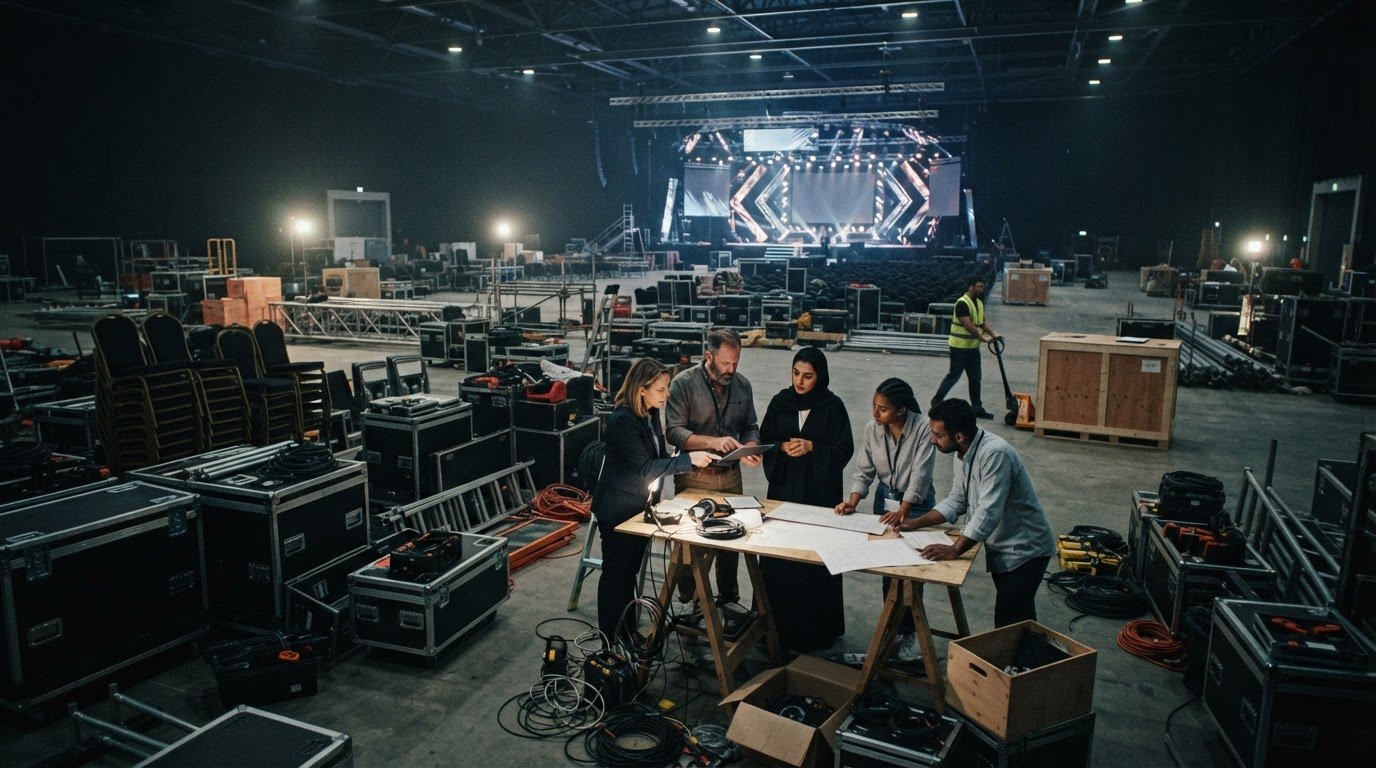
A budget rarely slips because of one dramatic decision. The common causes of event budget overruns are usually a chain of smaller changes: expanding scope, currency shifts, rushed decisions, weak cost tracking and expenses missed during planning. Each can put pressure on the total before delivery.
It’s reasonable to expect a carefully prepared budget to hold. But an estimate can guide decisions only when the scope is clear, costs are tracked as plans develop and changes are reflected in the numbers. This article explains how those factors drive costs up, why late decisions can bring extra charges, and how staffing, freight, customs, translation and technology costs can be overlooked. It also shows how contingency planning and clear financial oversight help teams spot pressure early and respond with greater control.
Key Takeaways
• Set clear scope boundaries and require written approval when a proposed change affects the event plan or budget.
• For international suppliers, account for how currency movements and payment timing can affect the final cost.
• Compare actual spending with the budget regularly so emerging pressure is visible while there’s still time to respond.
• Allow for the cost impact of late decisions, including expedited production, delivery and short-notice staffing.
• Look beyond headline quotes to identify potential staffing, freight, customs, translation and technology expenses.
How does poor scope definition drive up event costs?
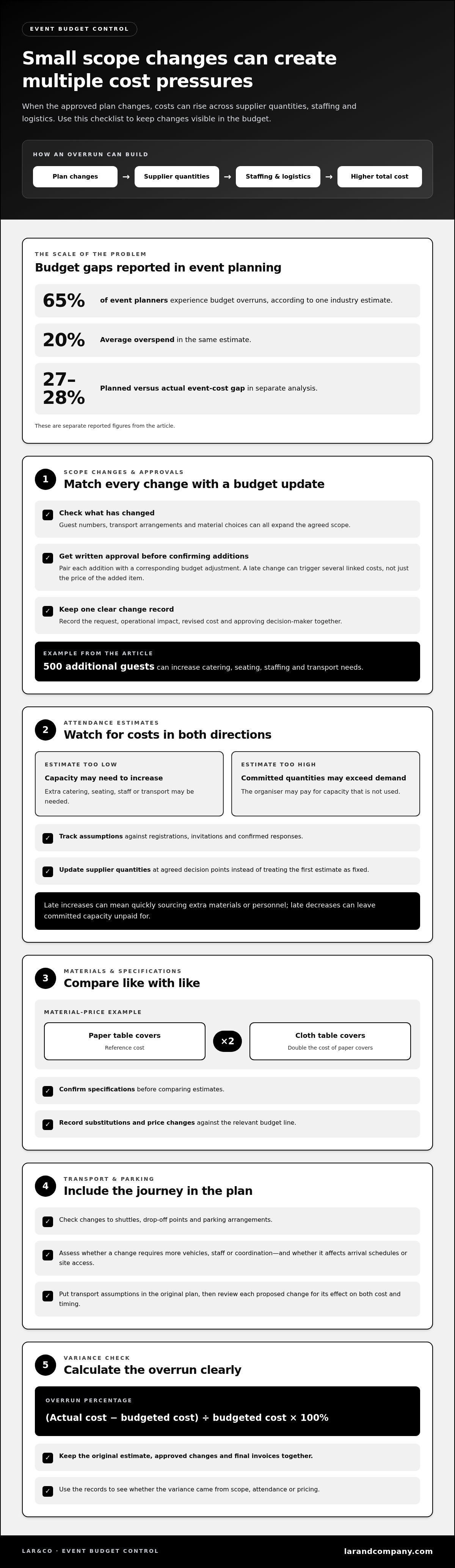
Event costs rise when the approved plan changes without a corresponding budget adjustment. Guest numbers, transport arrangements and material choices can all expand the original scope.
For conferences, weddings, festivals and corporate events, the pressure points differ: delegate facilities, guest services, site operations or programme requirements may change. In each case, additional requirements affect supplier quantities, staffing and logistics.
One industry estimate says 65% of event planners experience budget overruns, with average overspend of 20%. Separate analysis puts the gap between planned and actual event costs at 27-28%.
Scope changes and approval delays
Scope change means altering an event’s agreed requirements after planning or pricing has begun. It matters because a late addition can trigger several linked costs, not just the item itself. Inviting an additional 500 guests, for example, can increase catering, seating, staffing and transport needs. Require written approval for each addition, alongside a corresponding budget adjustment, before confirming the change.
Approval timing affects the available options. A revised requirement agreed early may let suppliers adjust quantities within existing plans. A decision made after orders or schedules are set can mean new production, extra labour or changed delivery arrangements. Record the requested change, its operational impact, revised cost and approving decision-maker together. This creates a clear record of why the forecast changed.
Attendance estimate errors
An attendance estimate is the expected number of people who will attend and use event services. If it is too low, organisers may need extra catering, seating, staff or transport capacity. If it is too high, committed quantities can exceed actual demand. At a conference, a revised delegate count can affect room layout and catering orders; at a festival, it can change site staffing and transport plans.
Track attendance assumptions against registrations, invitations and confirmed responses. Update supplier quantities at agreed decision points instead of treating the initial estimate as fixed. A late increase can be costly when suppliers must quickly source additional materials or personnel. A late decrease can leave the organiser paying for capacity already committed. These are common causes of event budget overruns.
Material prices can shift between an initial estimate and a confirmed order. A design choice can also change the unit cost: in the cited example, cloth table covers cost double the amount of paper covers. Confirm specifications before comparing estimates, then record substitutions and price changes against the relevant budget line.
Transport and parking changes can extend the scope beyond the venue. Adding a shuttle, changing drop-off points or revising parking arrangements may require more vehicles, staff or coordination. These changes can also affect arrival schedules and site access. Include transport assumptions in the original plan, then assess each proposed change for its effect on both cost and timing.
For a clear overrun calculation, subtract the budgeted cost from the actual cost, divide the difference by the budgeted cost, then multiply by 100%. Keep the original estimate, approved changes and final invoices together; this shows whether the variance came from scope, attendance or pricing.
Currency fluctuations and international supplier pricing
Currency shifts alter international supplier quotes; service charges can exceed 25%, while taxes add 8-10%. Cancellation insurance typically costs between 1% and 3% of the total event budget, and contract clauses can create further obligations.
Currency effects on international suppliers
A currency fluctuation changes the exchange rate between a supplier’s currency and the event’s budget currency. An unchanged supplier quote can therefore require more budget after conversion. For example, a production invoice priced in euros may cost more in dollars if the dollar weakens before payment.
Separate the supplier’s quoted amount from the converted budget figure. Record the quote currency, conversion assumption and payment dates in the cost forecast. Compare the planned exchange rate with the rate used when each payment is due. If the supplier invoices in stages, track each instalment separately: a shift between deposit and final payment can change the total converted cost.
Payment timing and contract wording shape currency exposure. A fixed quote in the supplier’s currency may hold the quoted amount steady while leaving the event budget exposed to exchange-rate movement. A quote in the budget currency can place more currency risk with the supplier, which may affect its terms. Identify the billing currency before approving the forecast, then update the conversion assumptions when payment commitments change.
Vendor pricing and contract terms
Vendor pricing is the full amount payable for an agreed service, including charges and contract conditions. A headline quote may not show the complete event commitment. Venue proposals, for example, may exclude audiovisual services, furniture, staffing, catering minimums or service charges.
Read each proposal alongside its contract terms. Venue exclusivity clauses can require preferred suppliers, who may charge a premium. Food and beverage minimums can create payment obligations beyond the initial proposal. Hotel attrition clauses may penalise organisers when a room block is not fully used. These terms affect costs even when the event plan remains unchanged.
Compare supplier proposals on the same basis: service description, included labour, delivery hours, exclusions and payment conditions. Track delivery hours against the agreed schedule, separating setup, event operation and breakdown. Venue contracts may charge overtime when setup or breakdown runs beyond standard hours. A late finish can therefore turn extra hours into an unexpected invoice line.
Keep service charges and taxes visible as separate budget lines. Event service charges alone can add over 25% to costs, while taxes can add another 8-10%. Record cancellation terms beside the relevant supplier commitment, including the amount payable at each decision point. Event cancellation insurance typically costs between 1% and 3% of the total event budget, so include it separately when assessing financial exposure.
Contingency planning and budget tracking
A contingency gives an event budget room to absorb unexpected costs. Regular tracking shows whether the reserve is being used and why.
For a corporate event, one recommendation is to build a contingency of 10 to 15% into the budget. Other guidance recommends 10-20%, with the precise amount based on project risk and phase maturity. These ranges reflect differing levels of uncertainty, not a universal allowance. A complex event with evolving requirements needs a different risk assessment from a plan with settled specifications and firm supplier commitments.
A 15% contingency is also recommended to absorb unexpected cost swings. Treat it as a distinct budget line, not spare money for optional upgrades. Record each drawdown with its reason, amount and approving decision-maker. If a venue change uses part of the reserve, update the forecast immediately; the remaining balance then shows what is available for other risks.
Ongoing comparisons of actual spending against the approved budget help reveal variances early. Review committed costs as well as invoices already paid: signed supplier agreements can create future obligations before cash leaves the account. Compare each budget line with its forecast, actual spend and remaining commitments. Regular progress updates and transparent reporting give teams a shared view of pressure points and support faster decisions.
A Cost Performance Index (CPI) can help express cost performance. A CPI of 1.0 means the project is on budget. A CPI of 0.90 calls for corrective action, while 0.85 calls for immediate escalation. Teams may only recognise problems when CPI reaches 0.75, leaving less room to respond. Use the measure alongside line-by-line forecasts, since a single index can conceal which supplier or workstream is driving the variance.
• At each weekly review, compare actual expenditure with the approved budget.
• Include contracted commitments alongside paid invoices.
• Explain each variance, assign an owner and record the next action.
• Update the forecast when scope, supplier commitments or delivery assumptions change.
A 15-20% buffer in time or costs rarely prevents overruns on complex projects. A reserve cannot compensate for weak visibility or unresolved decisions. If projected costs exceed the approved amount, identify the affected budget lines and assess corrective options before further commitments are made. Clear reporting makes those choices visible while the event plan can still be adjusted.
Keep contingency separate from the working forecast throughout planning. The forecast should show expected costs; the reserve should show the remaining capacity for uncertainty. Review both regularly, and escalate when the CPI reaches the relevant threshold. This discipline makes emerging pressure easier to trace, rather than leaving the final invoice as the first clear sign of an overrun.
Last-minute decisions and rush fees
A late decision can increase costs even when the event scope stays unchanged. This illustrates how timing can affect supplier rates and delivery arrangements. When a decision arrives after production planning, suppliers may need to reorganise work, expedite delivery or arrange short-notice staffing.
Rush charges reflect compressed schedules and limited capacity. A supplier asked to produce materials quickly may need to rearrange existing work or use expedited production. Short-notice staffing can also cost more when people have to be secured quickly. The final amount depends on the task, timing and supplier arrangements, so record each urgent request separately from the original forecast.
Timing affects more than production. A delayed choice about staging, content or site layout can hold up connected tasks. For example, a late layout decision may affect equipment positioning, crew scheduling and setup plans. Those dependencies can compress the remaining schedule, increasing pressure on every team working before the event opens.
An inadequate schedule can lead to extra fees and expenses. Venue contracts may charge overtime when setup or breakdown falls outside standard hours. If a delayed decision pushes installation beyond the agreed window, the organiser may face additional charges. Map access, setup, rehearsals, event delivery and breakdown against the venue’s permitted schedule before approving the operational plan.
Use decision points to make timing visible. For each significant choice, record who is responsible, what information is needed and when suppliers need an answer. Set the date from the production schedule and supplier deadlines, rather than using an arbitrary buffer. If approval misses that point, identify the affected work and revised cost before authorising the next step.
Separate urgent requests from essential changes. A late request for a revised printed item, for instance, may require expedited production and delivery. Before proceeding, compare the cost and operational effect with alternatives, such as using the approved version or changing distribution. This prevents urgency from automatically becoming approval for extra spending.
Track each rush decision by its cause and consequence. Note whether the delay came from a pending approval, missing information or a supplier dependency. Record any premium rate, overtime or staffing change in the forecast. This helps teams identify recurring bottlenecks and set earlier decision points for future events. It also distinguishes schedule-driven overruns from costs caused by added scope.
Overlooked staffing, freight, customs, translation and technology costs
A supplier quote may cover equipment or materials without covering every task needed onsite. For example, setting up tables might be expected to take a few hours but instead take two days, requiring extra personnel. If the budget includes only the initial labour estimate, the extended work adds staffing costs that were missing from the forecast.
Staffing needs depend on the work schedule, site layout and event requirements. Setup, rehearsals, live delivery and breakdown each create distinct labour demands. Map those activities against the production plan, then identify who is needed at each phase. A delayed setup can keep staff onsite longer; a complicated layout can require more people than the original estimate allowed.
Technology costs can also vary with the chosen supplier and venue arrangements. In-house audiovisual services can cost double or triple the price of an external vendor. Compare the full service requirements, including operation and setup, rather than treating equipment alone as the technology budget. Sourcing from dedicated integrators such as JVG Sound Lighting & Visual Pty Ltd can help clarify equipment pricing and avoid unexpected venue markups. Confirm which components are included in the venue package and which appear in separate supplier estimates.
Freight planning should account for each shipment’s route, handling needs and delivery timing. A change in venue access or installation sequence can affect when goods arrive and how long they need to remain onsite. List equipment and materials by destination, delivery window and responsible team. This helps reveal coordination gaps, such as items arriving before the site can receive them.
Customs and tariffs add another layer to international event logistics. Tariffs have affected event planners since January 2025, and the previous year’s prices may not apply. For shipments crossing borders, identify the goods, origin, destination and timing early. These details shape the cost forecast and the planning needed around delivery. Avoid carrying forward an old supplier estimate without reviewing its assumptions.
Translation costs can be missed when an event serves audiences across languages. Budget requirements may include translated materials, interpretation or multilingual digital content. Identify audience languages and materials requiring translation before production begins. A late change to programme copy, signage or presentation content can trigger more work and affect delivery schedules.
Use a separate budget line for each area, then compare supplier estimates with the event schedule. Track staffing hours, freight milestones, technology requirements, translation deliverables and border-crossing assumptions. Record changes as they arise instead of hiding them inside general contingency. This makes it easier to identify which operational requirement is driving the variance.
For complex live events, work with a production team that can coordinate technical requirements and site delivery.
Lar&Co: Show Production
Lar&Co brings Show Production, Technical Production and Site Management together for complex live events. Turn to the team when a production involves connected creative, technical and site requirements, and budget decisions need to reflect how those elements will be delivered. Creative Direction shapes the event’s overall vision, while production planning translates that vision into coordinated delivery. Clear oversight helps teams see how decisions affect the wider plan and keep operational requirements visible as the event develops.
If your event calls for coordinated production and site delivery, contact Lar&Co to discuss your event.
Set the next event up for control
Make the next budget review a decision point, not simply a financial update. Give each major commitment a clear owner, record why it was approved and connect the working forecast to delivery decisions. This makes financial oversight part of production planning, rather than an exercise reserved for the final accounts.
The common causes of event budget overruns are easier to manage when decisions have clear ownership and a visible relationship to delivery. For productions with connected creative, technical and site requirements, Lar&Co’s Show Production, Technical Production and Site Management bring those disciplines into planning and execution.
Use your next planning conversation to establish the priorities, operational requirements and decision-making structure that will guide the work. Contact Lar&Co about your event to discuss how its production capabilities could fit your plans.
A considered start gives ambitious events a stronger foundation for delivery.
Frequently Asked Questions
Why do corporate events go over budget?
Corporate events often exceed budgets when planning assumptions don’t match delivery requirements. A change from a presentation-led meeting to a product launch, for example, can affect staging, content, guest movement and technical support. Costs can also rise when separate teams work from different versions of the plan. Use one approved event brief, assign an owner to each budget line and update the forecast whenever a delivery assumption changes.
What are hidden costs in event planning?
Hidden costs sit outside an initial headline estimate or emerge in operational details. Examples include venue internet, power, furniture handling, crew meals and additional access time. For an event with international guests, local transport or translated materials may also be overlooked. Review estimates line by line, comparing each supplier’s inclusions with the event’s actual requirements instead of relying on a single total.
What role does last-minute decision-making play in event overspending?
Late decisions reduce the time available to schedule work efficiently. A delayed choice about presentation format, for instance, can require new content preparation, revised technical plans and additional rehearsals. Suppliers may need to rearrange work or expedite delivery. Set approval dates against production dependencies, then escalate decisions that could affect other teams. This makes the operational impact visible before an urgent change becomes a commitment.
Why do venue and supplier costs so often exceed the original quote?
Initial quotes can describe a limited service rather than the full delivery requirement. A venue estimate may cover room hire, while the event also needs access coordination, furniture movement or technical support. Supplier proposals may also rely on assumptions about timings, quantities and responsibilities. Compare each quote with the event schedule and define who provides every item or task. This exposes gaps before they appear on later invoices.
What are the most common causes of event budget overruns?
The common causes of event budget overruns include unclear requirements, inaccurate forecasts, delayed approvals and poor visibility of committed spending. International projects can also face changing supplier costs or currency exposure. Treat each cause as a planning risk with an owner, an assumption and a review point. For example, assign someone to monitor attendance projections and someone else to reconcile supplier commitments against the current forecast.
Which event costs are most often underestimated, such as labour, catering, AV and venue fees?
Labour, catering, audiovisual requirements and venue-related charges are often underestimated because their final scope depends on event operations. A room plan may affect staffing; a programme change may alter catering times; a technical rehearsal may require additional crew hours. Build separate forecast lines for these requirements. Test each against the run of show, venue schedule and expected guest experience, rather than relying on broad allowances.
How do last-minute changes and rush fees increase event costs?
Last-minute changes can add costs by compressing production, delivery or staffing schedules. For example, revised presentation content may require new graphics, technical testing and approval in a shorter window. An urgent delivery can also disrupt planned transport or installation sequences. Before authorising a rush request, identify the affected work, delivery deadline and available alternatives. Record the decision and its financial effect in the current forecast.
How much contingency should an event budget include?
A common planning recommendation is a contingency of 10-20% of the event budget, with the level shaped by risk and planning maturity. A settled programme with defined supplier commitments presents different uncertainty from an evolving event with complex logistics. Keep the reserve separate from planned expenditure, and record each use with its reason and approval. Review the remaining allowance alongside forecast costs, rather than treating it as discretionary spending.