Backstage Support Services for Live Event Teams
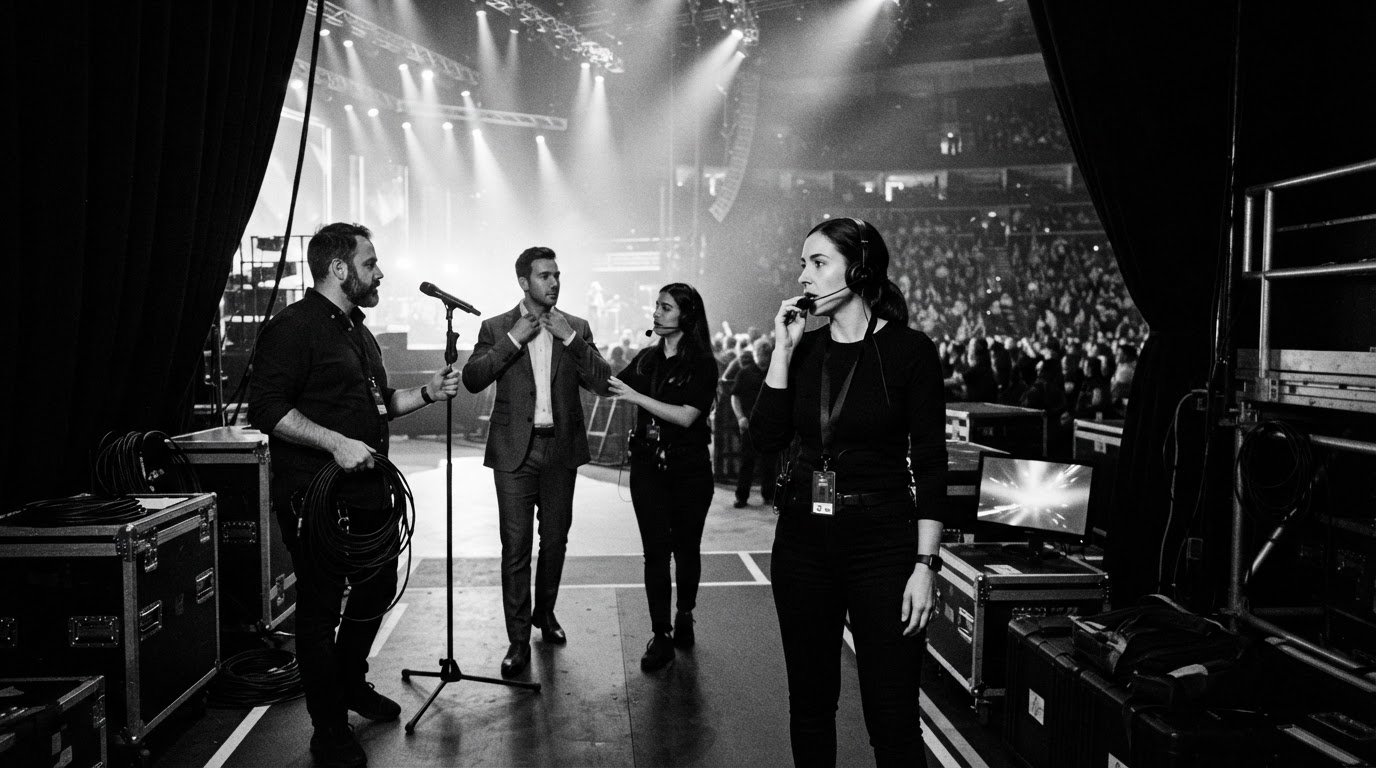
A clear backstage plan protects the guest experience and keeps the show on schedule. Backstage operations for live events coordinate artists, vendors and crew, manage cues and equipment, oversee transitions, and keep backstage movement separate from guest routes. Every handoff connects the running order with the people and spaces that bring it to life.
That coordination is easy to miss when everything runs smoothly. But a late entrance, an unready microphone or a route that crosses guest arrivals can disrupt both the programme and the atmosphere.
This article explains how backstage teams prepare performers and crew, manage cues and transitions, and organise access before, during and after an event. It shows how responsibilities, timing, communication points and vendor routes fit together, and how careful planning keeps backstage activity controlled without drawing attention away from the event.
Key Takeaways
• Align artist, vendor and crew communication with the run of show so readiness, handovers and hospitality needs are clear.
• Prepare people, props and microphones against the cue sequence, with a clear process for adapting when timings change.
• Plan backstage access, routes and waiting areas to keep operational movement separate from guest flows and event sightlines.
• Define backstage roles, spaces and equipment around the production’s needs, from load-in through post-event breakdown.
• For complex productions, Lar&Co’s Show Production can bring backstage coordination into the wider delivery plan.
Artist, vendor, and crew communication
A backstage communication plan links each person’s readiness to the live event sequence. The stage manager can use the running order to coordinate presenter calls, artist arrivals, vendor access and crew handovers. If a presenter is delayed, the team needs to know which entrance is affected and who can adjust the next cue. A clear sequence turns separate updates into one operational picture.
Start by naming a point of contact for each group. The artist liaison handles performer updates, while the production lead shares timing changes with the relevant crew. If a microphone is missing, for example, the stage manager can alert the audio team and the performer’s contact without broadcasting unnecessary details to every department. Record agreed changes in the working running order, then brief everyone whose tasks are affected.
Use a short communication chain for routine calls and a direct route for urgent changes. A practical briefing can confirm:
• Who is ready, where they are waiting, and which entrance they will use.
• Which crew member owns the next handover, such as passing a microphone or clearing a prop.
• Whether vendor access or catering timing affects an artist’s movement or readiness.
• Who updates the run of show when a cue or arrival time changes.
Artist requirements also need a discreet, practical handover. The coordinator can work with backstage catering to align hospitality with the artist’s rider. If a meal time changes, for example, inform catering and the artist’s contact rather than making a public announcement. Keep requests, decisions and outstanding actions in the appropriate production channel, with access limited to those who need the details.
Speakers may need private communication before an appearance. Give each speaker a clear contact and a quiet place to receive final instructions. A stage manager can privately confirm the entrance, microphone handover and revised running order, then pass only operational changes to the crew. This keeps personal arrangements off open production channels.
Close each handover with a direct acknowledgement. If a vendor is moving a lectern, the receiving crew member should confirm its destination and readiness. If an artist’s entrance changes, tell the door, stage and audio teams before the cue. These small confirmations reduce crossed instructions and help protect the programme when several departments are moving at once.
Cue support for people, props, and microphones
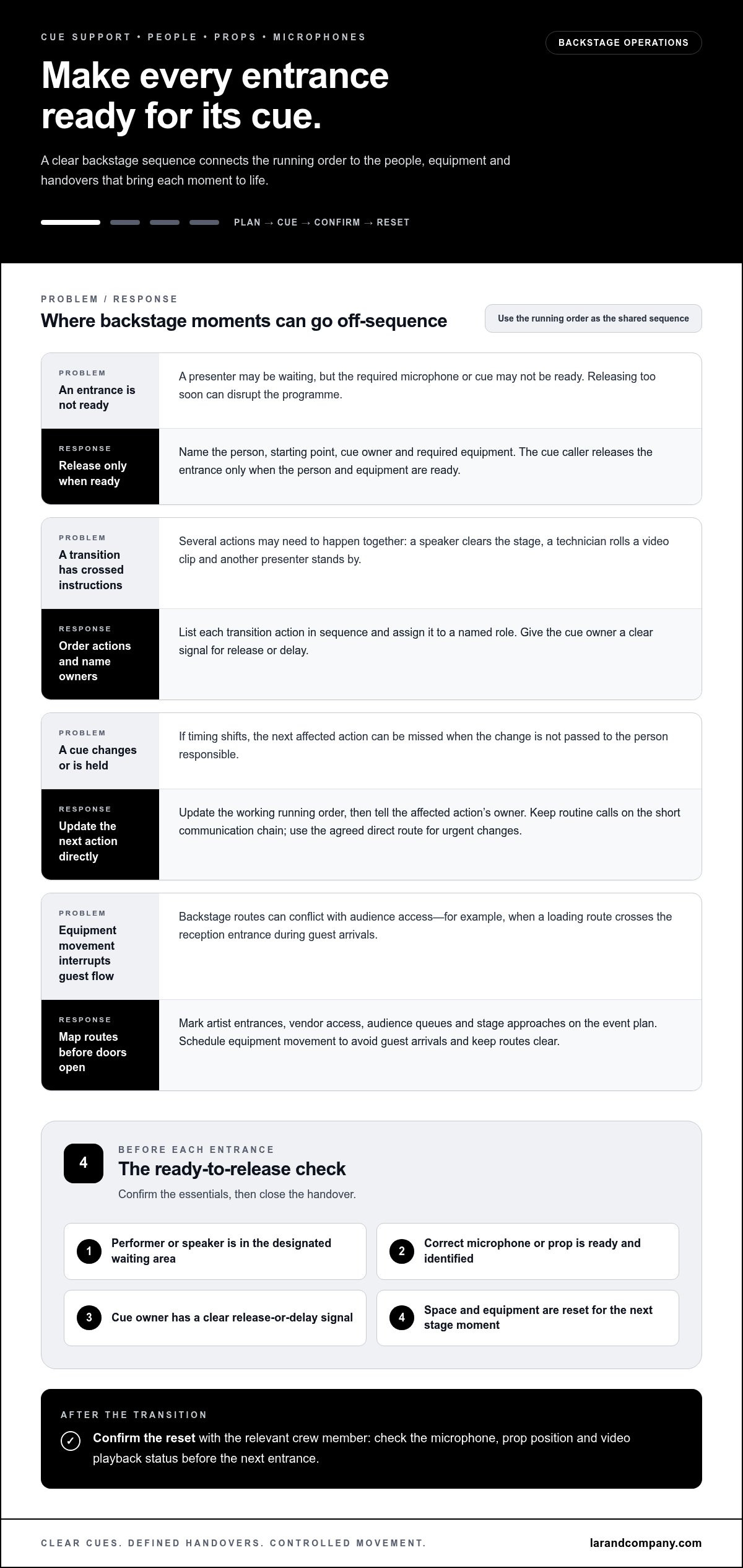
A cue plan turns the running order into clear backstage actions. For each entrance, identify the person, starting point, cue owner and required equipment. A presenter may wait beside the stage entrance while a crew member checks the lectern microphone. The cue caller releases the entrance only when both are ready. This gives departments a shared sequence and keeps movement deliberate.
Describe each transition in practical terms. A video segment may require a speaker to clear the stage, a technician to roll the clip and a second presenter to stand by. List those actions in order and assign each to a named role. Plan props the same way: note where they start, who moves them and where they finish. Show what changes if a cue is held, too.
• Confirm the performer or speaker is in the designated waiting area.
• Check that the correct microphone or prop is ready and identified.
• Give the cue owner a clear signal for release or delay.
• Reset the space and equipment for the next stage moment.
For US venues, applicable safety rules and permits depend on the venue, event activity and local requirements. Record relevant approvals, access controls, emergency routes and responsible contacts in the event plan. Where high-profile talent or executive guests are involved, working with risk mitigation and security specialists such as Palisade International LLC ensures physical security and perimeter access remain seamless alongside event operations.
Typical backstage staffing and labour costs in the US depend on the event and are provided after a quote request; the main factors are role mix, crew numbers, call length, venue requirements and event format.
Common backstage risks include blocked routes, unplanned equipment moves, missed cues and communication failures. The emergency procedure should identify who alerts venue control, how a show stop is called and which routes must remain clear. Crew should know their responsibilities before doors open, not during an incident.
The cue structure can be adapted for concerts, festivals, corporate events, weddings, community events and private celebrations. A concert may depend on artist entrances and instrument changes; a corporate programme may centre on speakers, slides and video playback. In every case, match the cue list to the actual running order. When timings shift, update the next affected action and tell its owner directly.
A speaker and event technology support chat can carry concise operational updates. Keep it focused on the event, with named participants for stage, audio and video. Post a change with the cue, revised action and owner, such as “Video two held; audio to keep the speaker at stage left.” Use a private channel for sensitive speaker details, and move urgent instructions to the agreed direct cue method.
After each transition, confirm that the stage is reset before the next entrance. The cue caller can check the microphone, prop position and video playback status with the relevant crew member. This closes one action and prepares the next. A precise cue sequence gives people and equipment defined places in the programme, even when a live event’s timing changes.
Backstage access and guest-flow separation
Map backstage movement against guest routes before doors open. Mark artist entrances, vendor access, audience queues and stage approaches on the event plan. If a loading route crosses the reception entrance, for example, schedule the movement to avoid guest arrivals. The aim is to move people and equipment without interrupting audience access or the event’s visual experience.
Assign each route a purpose and a point of control. Performers may need a discreet path from dressing rooms to the stage. Catering staff need access to backstage areas, while production vendors move cases towards work zones. Use signs, barriers or staff positions to make route boundaries clear. At each crossing, identify who pauses movement and who clears the route.
Check the plan by walking each route in sequence. Start at the vendor arrival point and follow the equipment path, then trace the artist entrance and guest journey. Note where a flight case could narrow a corridor or a queue could obscure a backstage door. Adjust the layout, timing or staff position before the routes are in use.
• Separate guest entrances from performer and vendor access where the site allows.
• Keep stage approaches and backstage doors clear during guest arrival.
• Set a control point where routes meet, with a named person managing movement.
• Mark equipment holding areas away from audience sightlines and circulation.
Room flow matters as much as the route itself. Guests moving from reception to the main space should not pass through a dressing-room corridor. Likewise, vendors carrying equipment should not cut across a presentation or performance area. Walk each guest transition from their perspective, then compare it with the backstage plan. Move waiting points or adjust access timing wherever routes conflict.
During the programme, coordinate backstage movement with the running order. A vendor may need to reposition equipment between sessions while an artist prepares for an entrance. Schedule the move when the relevant route is clear, and tell the people controlling both ends. If timings change, update the route owner before movement begins. This prevents an unscheduled crossing from disrupting a cue or the guest experience.
Plan the exit as carefully as arrival. After the programme, guests leave, vendors pack equipment and crews begin breakdown. Set separate routes and sequence these activities so cases do not meet departing guests at a doorway. Keep the access plan available to those directing each movement, and confirm the final route before breakdown starts.
Backstage access management brings together timing, venue access, vendor routes and room flow. A final walkthrough should test the plan under event conditions: check sightlines from guest areas, confirm doors remain usable and verify that equipment can pass without blocking audience movement. Record changes on the site plan and brief affected teams before the next transition.
What roles and responsibilities are needed for backstage event operations?
A backstage team needs clear ownership for each task, not overlapping job titles. The venue Production Manager provides the operational lead. A Backstage Experience Coordinator reports directly to that manager, meets touring parties on arrival, assigns dressing rooms and handles hospitality needs. This role connects venue arrangements with the needs of artists and touring teams.
The coordinator also oversees dressing-room and bus stock, including after-show meal coordination. Before the event, they can check room readiness against the schedule and identify missing supplies. During the show, they handle backstage requests and relay relevant changes to the Production Manager. Afterward, they can record service issues for follow-up.
Other responsibilities sit with the production team. The stage manager tracks the running order and cues entrances. Department leads coordinate their own crew and equipment. The artist liaison maintains direct contact with performers, while vendor leads organise deliveries and service activity. If a catering delivery affects a backstage route, for example, the vendor lead can alert the coordinator before it conflicts with artist movement.
Production Manager
oversees venue production and receives operational updates.
Backstage Experience Coordinator
manages touring-party arrival, dressing rooms and hospitality.
Stage manager
calls programme cues and confirms stage readiness.
Department leads
direct crew tasks, equipment handovers and technical preparation.
Vendor leads
coordinate supplier access, delivery timing and service areas.
Use a responsibility schedule to show who owns each task, who receives updates and who can approve changes. For dressing-room setup, the coordinator checks the room, the relevant department supplies agreed equipment and the Production Manager resolves venue-level constraints. This avoids sending the same request to several people without a clear decision-maker.
Load-in timing also shapes these roles. The production team can schedule backstage setup before performers or presenters need the space. The coordinator then checks that rooms and routes are ready. Pre-show and post-show walkthroughs should use a checklist to review backstage areas and record any damage requiring repair. That record gives the venue team a clear follow-up.
Financial duties can be shared where applicable. The coordinator may co-manage backstage programme budgets and process vendor invoices with the General and Production Managers. A clear handover should identify the relevant cost centre, approval route and supporting documents. The assigned managers can then reconcile invoices against delivered services and agreed event needs.
Close the event with a short service recap. Record what worked, outstanding repairs and supplier issues that need action. The coordinator can use venue service reports to develop improvement plans with relevant teams. This turns observations from one event into specific preparation for the next production.
What backstage areas and equipment are required for a live event?
Plan backstage spaces around the programme, people and equipment. A concert may need dressing rooms, an artist holding area, instrument storage and a clear stage approach. A corporate event may need a speaker waiting area, a control position and a place to prepare presentation materials. The event format and site layout determine which spaces are essential.
Start with a site plan. Mark each room, entrance, storage point and route between backstage and the stage. Give every area a clear purpose, such as performer preparation, crew coordination or vendor staging. Keep cases and spare equipment out of working routes. For example, locating instrument storage beside the stage can reduce unnecessary movement during a changeover.
Dressing and holding areas
provide a defined place for artists and speakers to prepare and wait.
Production work area
give the stage manager and relevant crew space to review the running order.
Equipment storage
assign places for props, instruments, microphones and presentation materials.
Vendor staging area
identify where deliveries can be held before they move into position.
Stage access
preserve a practical route from holding areas to entrances and performance positions.
Match equipment to each planned activity. A speaker event may require lectern microphones, presentation materials and a defined place for the next speaker. A concert may need instrument stands, labelled cases and a prop holding point. Create an equipment list for each area, then assign responsibility for placing and resetting each item. This makes missing items easier to spot during setup.
Room contents should support the people using them. A dressing room may need chairs, tables, mirrors and clearly identified storage. A production work area may need the current running order, contact information and a surface for equipment notes. Place supplies where they will be used, rather than creating another storage problem in a corridor or entrance.
Walk the layout before the event begins. Check that a case can move from vendor staging to its assigned storage point and that a performer can reach the stage without crossing a work area. Confirm that labels match the site plan. If a room changes purpose, update its signage and tell the people who rely on it.
For complex layouts, connect room planning with the wider site and production plan. Include your backstage layout and equipment plan in the production discussion.
Backstage planning coordinates entrances, waiting areas, readiness timing, communication points and responsibilities. Load-in scheduling and setup coordination prepare these areas before performers or presenters need them.
Lar&Co: Show Production
Lar&Co delivers Show Production for complex live events where creative intent and precise backstage operations must align. Its team connects the running order, technical requirements and site logistics, giving artists, vendors and crew a coordinated framework to work within.
Technical Production supports the systems and transitions behind each show. Site Management connects backstage movement with the wider event environment, while Creative Direction shapes the experience those operations serve. These disciplines are relevant when a production involves multiple teams, complex stage moments or guest and vendor routes that need careful coordination.
For a live event requiring joined-up production planning, contact Lar&Co about your event.
Set the next production in motion
Your next planning decision is where backstage coordination belongs within the wider production. Treat backstage operations for live events as part of the event’s core design, not a final layer added after the programme and venue plan. That gives the team room to align creative ambition with practical delivery from the outset.
Begin by setting the production priorities: the experience you want guests to have, the moments that need precise execution and the operational decisions that must be made early. This brief gives planning a clear foundation and helps keep teams focused as details develop.
Lar&Co offers Show Production, Technical Production and Site Management to support live event delivery. If you’re shaping a production and need an experienced partner to bring its operational elements together, contact Lar&Co about event support. A considered start can give the whole team a stronger path into delivery.
Frequently Asked Questions
What are backstage operations for live events?
Backstage operations for live events coordinate the people, spaces, information and practical decisions that support a programme away from the audience. They connect show timings with performer preparation, technical activity and supplier movements. At a conference in London, for example, the backstage team may align a speaker’s presentation file with the session schedule and room changeover, so the stage handover is ready at the right point in the programme.
How do stage managers coordinate performers, crew, cues, and schedules?
Stage managers coordinate production through a shared running order and clear decision-making. They track the live programme, record approved changes and inform the affected departments. If a discussion runs long, for example, the stage manager can update the next transition and alert the relevant teams. One current version of the schedule helps prevent crew from acting on outdated timings or conflicting instructions.
How do backstage operations differ for concerts, theatre, and corporate events?
Backstage priorities depend on the format and how the programme unfolds. A concert may involve changing performers, instruments and stage configurations. Theatre usually follows a scripted sequence, with entrances, props and scene changes tied to the performance. A corporate event may focus on speakers, presentations and screen content. In premium motorsport hospitality, such as Grand Prix events produced by AIOKA, back-of-house teams focus heavily on keeping discreet catering and vendor movement entirely separate from VIP guest areas. A touring production in the US or a gala in the UAE also needs plans shaped around its venue and programme.
What backstage communication systems and event management tools are commonly used?
Teams commonly combine two-way radios or headsets for immediate coordination with written schedules and contact lists for reference. A shared production document can hold the latest running order, responsibilities and supplier timings. The stage team might use radios for live calls while the production office records approved schedule changes. Keep sensitive speaker information in a restricted channel, and make the current document easy for authorised teams to identify.
What safety rules and permits apply to backstage operations at US venues?
Applicable safety rules and permits depend on the venue, event activity and local requirements. Record relevant approvals, access controls, emergency routes and responsible contacts in the event plan.