5 elements of an unforgettable brand activation
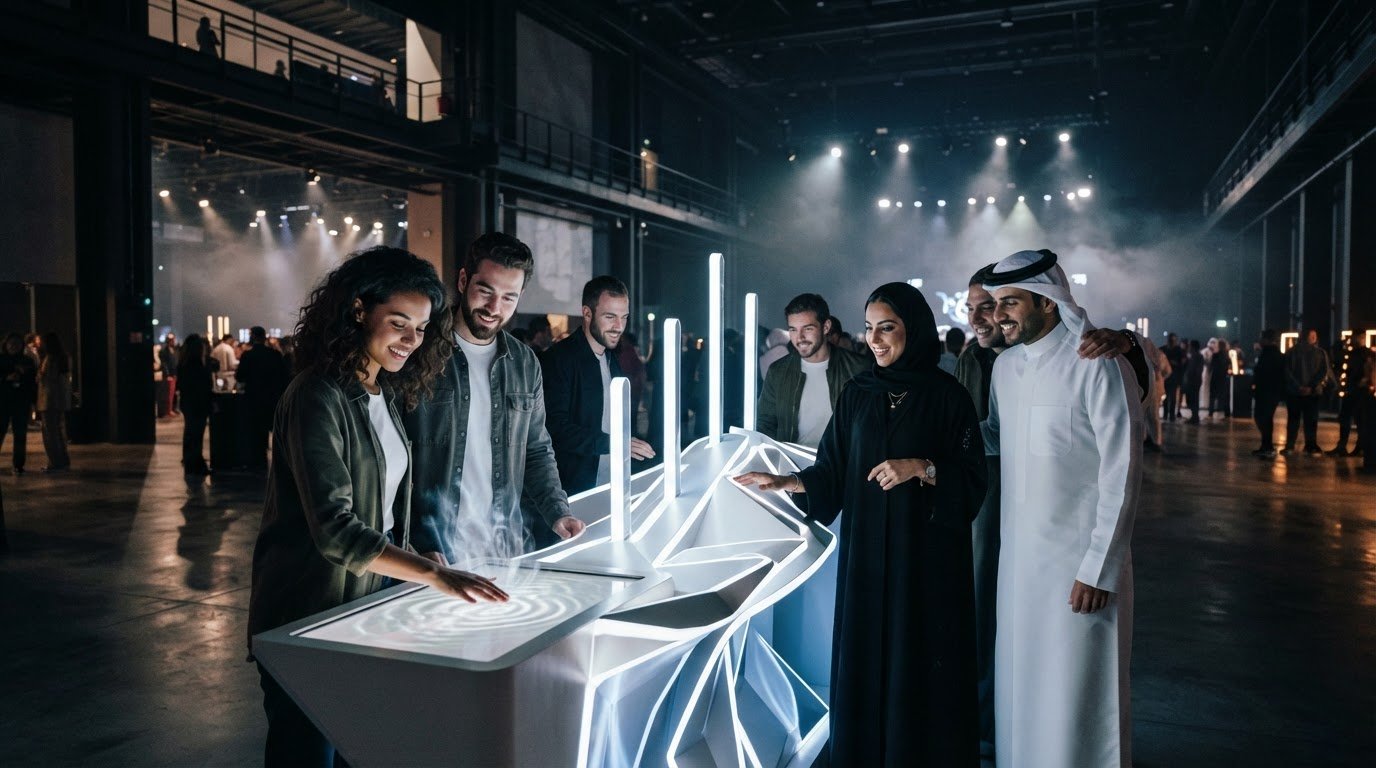
To understand how to produce an unforgettable brand activation, start with a clear purpose and a precise picture of the audience. A brand activation invites people to take part, turning passive attention into an experience through interaction, demonstration or live entertainment. Its impact depends on connecting that experience to the brand’s goals, then measuring what it achieves.
A striking installation can attract attention, but attention alone does not define success. Strong campaigns give people a reason to engage, make the interaction relevant and create a natural path from first impression to follow-up.
This article covers five elements of an effective activation: audience insight, clear objectives, purposeful creative, considered delivery and meaningful measurement. It also explains how to capture leads and connect pre-event promotion, the live experience and post-event marketing, so the campaign works as one coherent whole.
Key Takeaways
• Make participation central: an activation should give people a relevant way to experience the brand, not just see it.
• Start with audience motivations and build an interaction that feels useful, distinctive and suited to the setting.
• Choose success measures that match the campaign objective, and make lead capture part of a clear follow-up journey.
• Connect promotion before the event, the live experience and post-event communications to extend the campaign’s impact.
• Bring creative direction and practical delivery together so the concept works for both the audience and the event environment.
1. What is brand activation?
Brand activation turns a brand promise into an experience people can take part in. Grounding that promise in a cohesive identity is essential, and organisations often collaborate with agencies like Branding TITANS™ to build the strong brand identities and mission statements that underpin successful campaigns. Unlike a conventional advert, an activation invites the target audience to interact through a demonstration, sample, challenge or live performance. Experiential marketing is the broader approach: it creates direct encounters that let people experience a brand, not just hear its message. Start by defining what someone should understand, feel or do after taking part.
Participation gives the brand narrative a practical form. A sustainability message, for example, could become a repair workshop where visitors learn to extend a product’s life. A performance-led brand might invite guests to contribute a sound or movement to a live installation. In each case, the activity should make the message tangible. If the story is about craft, let people handle materials or watch a maker at work. If it is about discovery, give them a choice that changes what they see next.
Design the experience around the way people will engage. A high-traffic area suits a quick game or product sample, whilst a lounge supports longer conversation. Festivals can use photo experiences and interactive games; conferences can make room for demonstrations or practical workshops. A 360-degree camera can create a shareable moment as guests pose or move with themed props. These formats work best when the interaction feels natural to the setting and gives participants a clear reason to stay, contribute or share.
Immersive experiences can also transform a physical location into part of the story. Adidas’ Jump Store activation placed free trainers on shelves 10 feet high, turning the challenge of reaching them into the central interaction. The lesson is not to copy the spectacle, but to connect the location, activity and brand idea. Creative Direction can shape that connection, aligning visuals, movement and sensory cues so each moment supports the same narrative.
For US activations, permit and insurance requirements depend on the venue and local jurisdiction. Plan accessible routes, queues, viewing positions and ways to participate, then align the setup with applicable venue and local requirements. A brand activation’s cost depends on its scale, location, creative, production, staffing and technology; pricing is given after a quote request.
To understand how to produce an unforgettable brand activation, start with the audience’s experience rather than the structure or spectacle. Map the journey from first sight to final interaction, then test each touchpoint against the brand story. A tasting station, for instance, can combine product trial, a short explanation and a simple next step. When every element has a purpose, the activation becomes a coherent encounter rather than a collection of effects.
2. KPIs, lead capture, and measuring campaign impact
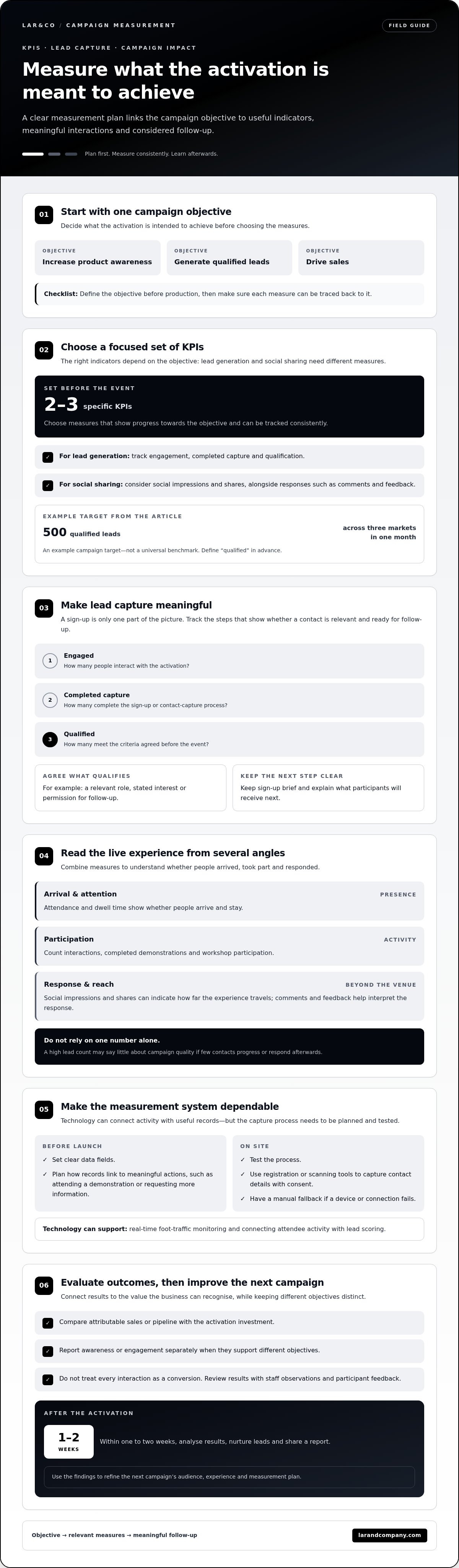
Set the measurement plan before production begins. Start with one objective, such as increasing product awareness, generating qualified leads or driving sales. Then choose measurable indicators that show progress towards it. A campaign designed to capture contacts needs different KPIs from one intended to encourage social sharing. Define two or three specific KPIs before the event and make sure each can be traced to the objective.
For lead generation, count more than sign-ups. Record how many people engage, how many complete the capture process and how many meet agreed qualification criteria. A sample target could be 500 qualified leads across three markets in one month. The figure only becomes useful when the team defines “qualified” in advance, such as a relevant role, stated interest or permission for follow-up. Keep the sign-up process brief and explain what participants will receive next.
Attendance and dwell time show whether people arrive and stay. Interactions, completed demonstrations and workshop participation reveal how actively they engage. Social impressions and shares can indicate how far the experience travels beyond the venue, while comments and feedback help interpret the response. Combine measures rather than relying on a single number. A high lead count, for example, says little about campaign quality if few contacts progress or respond afterwards.
Event technology can help teams monitor foot traffic in real time and connect attendee activity with lead scoring. Use registration or scanning tools to capture contact details with consent, then link records to meaningful actions, such as attending a demonstration or requesting more information. Set clear data fields before launch and test the process on site. A reliable measurement system should also have a manual fallback, so staff can record essential interactions if a device or connection fails.
To assess return on investment, connect campaign costs with outcomes the business can value. Compare attributable sales or pipeline with the activation investment, and report awareness or engagement separately when they support different objectives. Avoid treating every interaction as a conversion. Review the data alongside staff observations and participant feedback to understand what drove meaningful connections. Within one to two weeks after the activation, analyse results, nurture leads and share a report. Use the findings to refine the next campaign’s audience, experience and measurement plan.
3. Understanding audience motivations and preferences
Identify the people an activation needs to reach before choosing its format. The National Institute of Standards and Technology (NIST) describes a general audience-identification process that starts by identifying ideal customers, what matters to them, how they benefit and where to find them. Apply those prompts to the campaign: a product launch may prioritise potential buyers, while a community event may focus on local residents and cultural groups. To identify the target audience and choose the right format, research people’s motivations, then select an experience that suits their needs, setting and decision journey.
Build a useful audience profile from existing customer conversations, sales questions, event feedback and social media engagement. Look for recurring needs, barriers and interests rather than relying only on broad labels such as age or generation. For a sports brand, runners may value practical recovery advice more than a branded photo opportunity. For a technology company, prospective customers may prefer a guided demonstration that lets them explore a product’s features. Each insight should inform what participants will do.
Segment the audience by behaviour and intent. A first-time visitor might need a simple introduction, while an existing customer may welcome an advanced workshop or preview. Map each group’s journey from discovering the activation to deciding whether to engage. Then consider where each group is likely to encounter it: a conference floor suits a focused professional audience, while a public festival attracts a different mix of interests and expectations. The setting shapes both the invitation and the experience.
Audience psychology matters because a memorable interaction gives people a reason to care. A visitor who can customise an object, contribute to a collective artwork or try a product gains a personal stake in the encounter. Participation can make a brand story easier to understand than a display of claims alone. Design for a clear emotional response, such as curiosity, pride or delight, and make the connection to the brand visible. A shared storytelling wall, for example, can link individual contributions to a wider community theme.
Test the format against audience preferences before committing to a full build. Share a simple concept with representative customers, observe which details prompt questions, and revise anything that confuses or excludes. A quiet, considered setting may suit a premium tasting; a fast-moving challenge may work better in a busy public space. Offer different ways to participate, from hands-on interaction to observation, to welcome varied comfort levels. Use feedback and engagement patterns to refine future activations, strengthen awareness and leave a lasting impression with the people the campaign is designed to reach.
4. Integrating pre-event, live, and post-event marketing
Experiential marketing is the broader approach; pop-ups are temporary physical spaces, events gather audiences around a shared occasion, and digital activations engage people online. Choose a format according to campaign objectives, audience behaviour and the kind of meaningful interaction the brand can sustain across channels.
Plan in sequence: set the objective, choose the format, align the message, then coordinate promotion, live delivery and follow-up. Begin pre-event social media campaigns and influencer outreach 2–4 weeks before the activation, using a clear invitation that reflects the brand’s values and tells people what they can experience. A teaser might reveal one element of an installation, whilst a registration message can explain what attendees will gain.
During the activation, give people a natural way to share a moment and extend its reach beyond the venue. Visa Live at Le Louvre combined digital technology with live performance, engaging people on site and audiences on social media. MLB London Yards used interactive experiences, live entertainment and social media integration to introduce baseball culture to a new audience in London. Both examples connect a live encounter to a wider story rather than treating social content as an afterthought.
Match the format to the event and audience. B2B activations can centre on education, product demonstrations, networking or practical workshops. A virtual version can use guided demonstrations, interactive sessions or live questions; a hybrid format can connect those digital elements with activity at the physical venue. For conferences, a workshop can offer focused value, whilst a festival may suit an immersive installation. Keep the central message consistent, but adapt how people participate across channels.
After the event, continue the conversation with relevant content, follow-up and a clear next step. Share highlights that capture the atmosphere, then tailor communications to what people did: a workshop attendee may value an in-depth resource, while someone who requested product information needs a direct response. This turns a brief impression into an ongoing relationship and gives the campaign a useful post-event phase.
Key risks include poor crowd flow, technology failure, inconsistent delivery and a concept that misses its audience. Mitigate them with quality control, trained staff, contingency plans, crowd-flow management, real-time monitoring and tested technology integration. Assign an owner to each task, rehearse the run-of-show and prepare a manual process for essential interactions if digital tools fail. These steps help align pre-event promises with the live experience and post-event follow-up.
5. Core elements of a successful brand activation
A successful brand activation combines five elements: a clear objective, audience relevance, a coherent idea, considered delivery and measurable outcomes. Set the objective before choosing a venue or designing an installation. If the target is product understanding, build an experience that lets people explore the product. If the aim is community engagement, give participants a shared role, such as contributing to a collective display.
Next, make the creative idea serve both the brand and the audience. Interactions, visuals and messages should reinforce the same promise rather than compete for attention. Ford product launches, for example, combined innovation, digital campaigns and live events. Bringing those elements together gave people more than a single reveal: each channel supported the launch story and helped carry it beyond the event.
Design the space as part of the story. A cohesive activation aligns spatial design and visual elements with the brand’s values, so visitors understand the experience as they move through it. Engaging signage and display specialists such as Signarama can ensure that physical graphics and branded structures reflect those standards accurately. Consider all five senses where they suit the concept: sound can shape atmosphere, texture can invite touch, and a distinctive scent can mark a particular moment. Give every sensory detail a purpose. Unrelated effects add complexity without strengthening the message.
Choose a format that fits the audience, setting and interaction. Open spaces can accommodate immersive environments or large installations; lounge areas support conversation and networking. A live demonstration or workshop gives attendees a chance to try something or learn a skill. Collaborative art can turn individual contributions into a shared experience, while a designed photo or video moment can encourage social sharing. Make the intended action clear, whether it is exploring, learning or contributing.
Plan delivery with the same care as the concept. Quality control, trained staff, contingency plans, crowd-flow management, real-time monitoring and technology integration help keep the experience coherent on site. Check sightlines, participant movement and staff responsibilities against the run-of-show, then rehearse key transitions. This can reveal practical problems before they disrupt the audience’s experience. A memorable activation depends on disciplined execution, not spectacle alone.
Use these elements as a working test: can the audience recognise the idea, take part and connect it to the brand? If the concept needs complex instructions or disconnected features, refine it before production. Discuss your activation concept and shape the creative and delivery plan around its objectives.
Lar&Co: Show Production
Lar&Co can turn an activation concept into a live experience, with Show Production shaping delivery from creative plan to event floor. Bring the team in when the idea needs coordinated production, technical planning or site management to work in a real venue. Creative Direction aligns the experience’s visual and spatial choices with its central message, while Technical Production supports their practical delivery.
For a campaign with several moving parts, these disciplines provide a clear route from concept to execution. The support required depends on the activation’s format, setting and production needs.
Contact Lar&Co to discuss your brand activation.
Turn the concept into a live experience
The question of how to produce an unforgettable brand activation becomes practical when the idea meets its venue, schedule and audience. Before production begins, create a concise working brief: define the intended experience, identify moments that need careful coordination, and map how guests move through the space. This gives creative decisions a clear reference point and helps resolve operational details early.
Lar&Co’s Show Production, Technical Production and Site Management support the planning and delivery of complex live experiences. These disciplines bring the concept, technical requirements and event environment into one coordinated production plan. Discuss the activation’s ambition, format and setting with Lar&Co to establish what delivery requires.
Contact Lar&Co to plan your activation. A considered brief gives a strong idea the structure to make its mark.
Frequently Asked Questions
What is brand activation?
A brand activation is a campaign that gives people a direct way to experience or respond to a brand. Unlike a standard advert, it makes audience participation part of the communication. For example, a homeware brand might invite visitors to arrange a sample room, helping them explore products in context. The interaction should make the brand’s purpose easier to recognise and remember.
Why should a business invest in experiential marketing?
Experiential marketing can make a brand easier to understand by letting people encounter its offer in a real setting. A new food brand, for instance, can use a tasting to introduce unfamiliar flavours and gather immediate reactions. Direct contact can reveal questions or preferences that a digital impression alone may not show. Businesses can use those observations to refine messaging, product explanations or future campaign experiences.
What makes a brand activation unforgettable and effective?
An effective activation gives the audience a distinctive role and makes the brand connection clear. Consider a travel company inviting guests to build a miniature itinerary from destination cards, then revealing a route based on their choices. The activity creates a personal moment, while the final reveal reinforces the company’s purpose. Distinctive details matter when they support the central idea rather than distract from it.
How do you define goals and KPIs for a brand activation?
Begin with the business decision the activation should influence, then choose an observable action that indicates progress. If the aim is product consideration, track completed demonstrations and subsequent requests for product information. If it is community awareness, monitor attendance and relevant audience feedback. For activations in the UK, US, UAE, Saudi Arabia or Qatar, tailor the audience definition and campaign measures to each market’s objectives.
How can interactive experiences and storytelling increase brand engagement?
Interaction lets participants influence what happens, while storytelling gives that action a reason. A fictional example is a skincare brand creating a choose-your-routine station, where visitors select concerns and receive a tailored product sequence. The choices make the experience personal; the story explains why each option matters. Keep the sequence simple so participants understand the connection between their decisions and the brand’s message.
How do you measure brand activation results and calculate ROI?
Compare the campaign’s attributable financial return with its total investment: subtract investment from return, then divide by investment. Express the result as a percentage if the underlying figures support that calculation. For example, connect tracked purchases or qualified sales opportunities to the activation, rather than assigning every later sale to it. Report non-financial results, such as engagement or audience feedback, separately to show the wider campaign effect.
What permits, insurance, and accessibility rules apply to brand activations in the United States?
Permit and insurance requirements depend on the venue and local jurisdiction. Plan accessible routes, queues, viewing positions and ways to participate, and align the setup with applicable venue and local requirements.