Event Health and Safety Management: A Checklist for High-Profile Productions
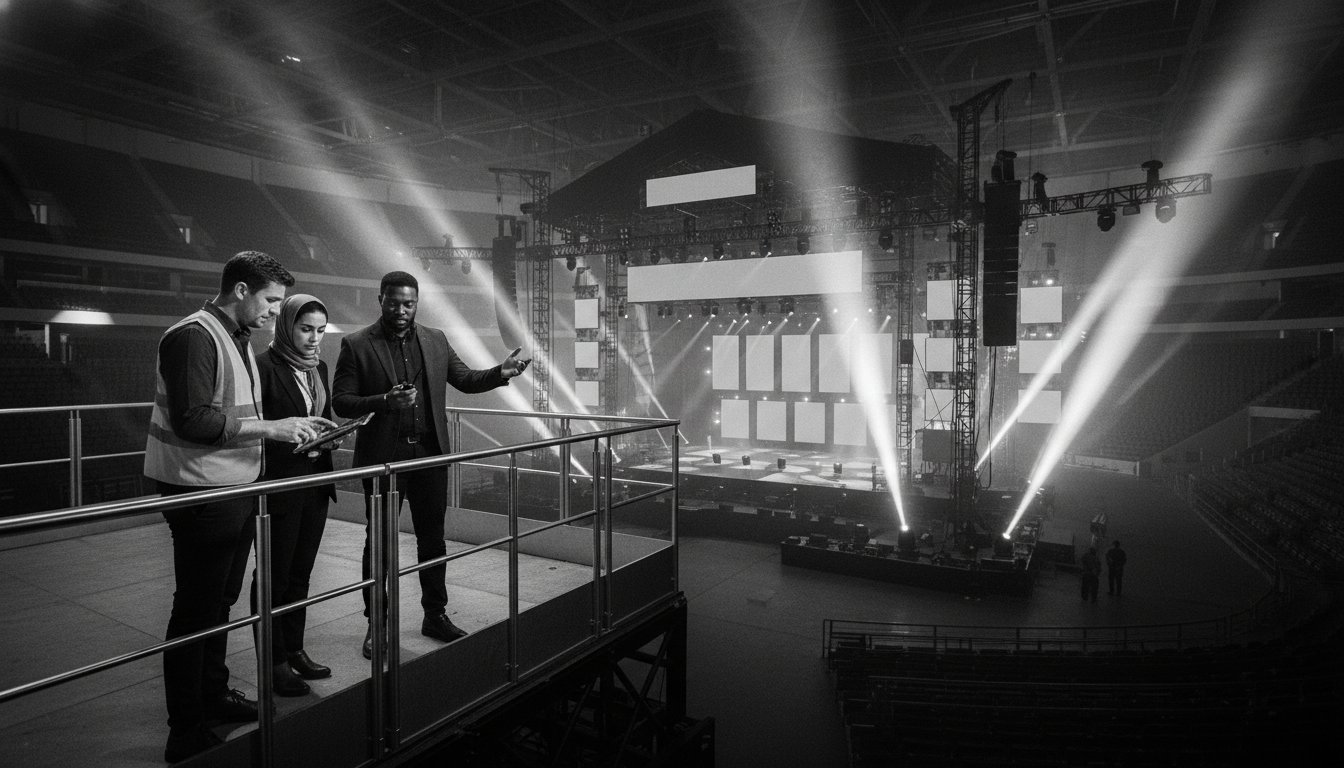
The most ambitious stage designs are not limited by safety protocols; they are protected by them. In the world of high-stakes live entertainment, the margin for error is non-existent. You understand that managing a global tour or a major civic event requires more than just a basic list of rules. It demands a sophisticated approach to event health and safety management that integrates seamlessly with your creative vision. Whether you are organising diverse crews across continents or interpreting conflicting international regulations, the pressure to deliver a flawless production is immense.
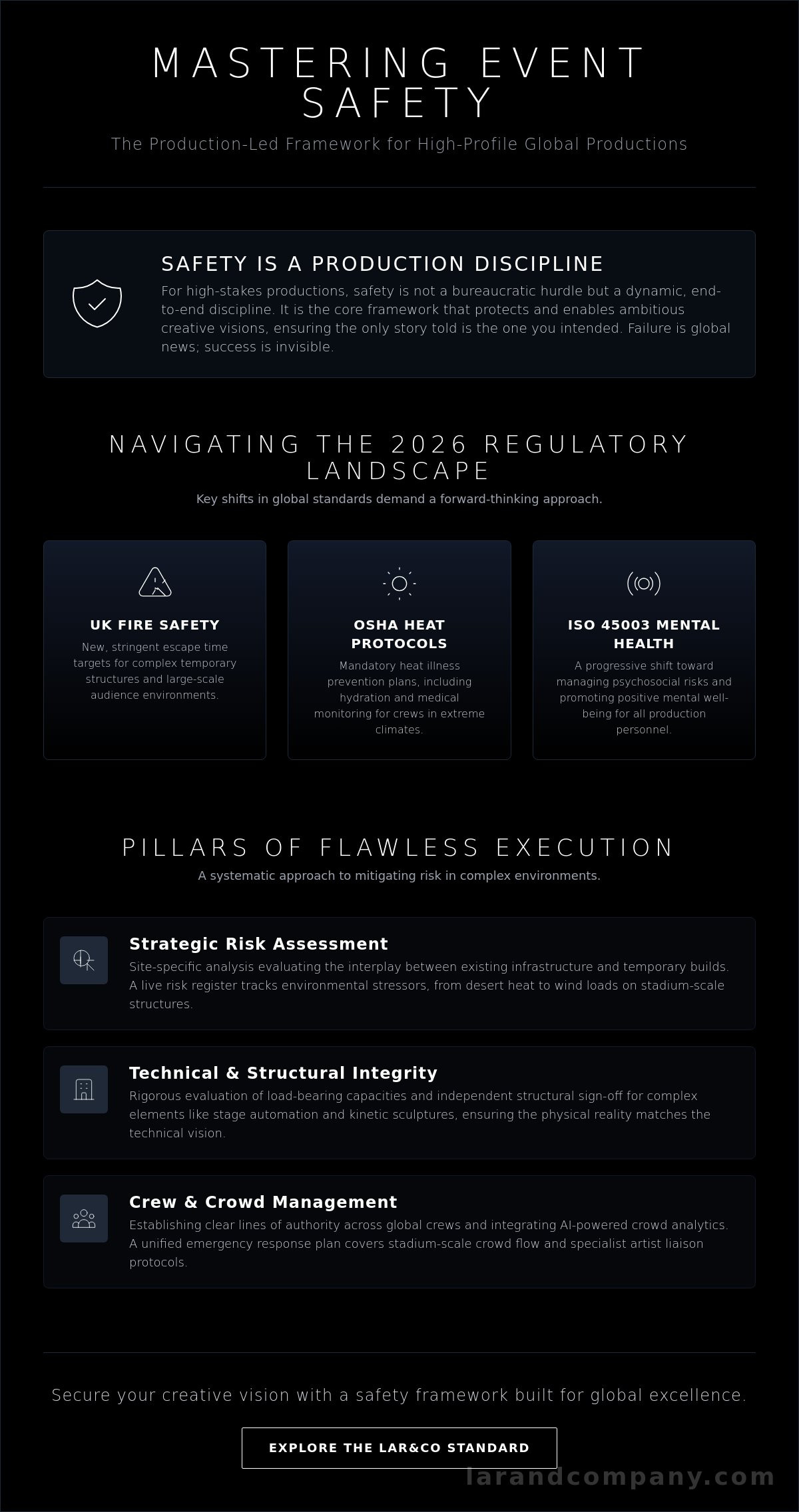
This guide provides the expert-led framework needed to master these complexities. We've distilled the latest 2026 standards, such as UK fire safety escape time targets and new OSHA heat illness protocols, into a functional strategy for global productions. You will learn how to balance structural integrity with bold aesthetics whilst ensuring full regulatory compliance across every jurisdiction. We examine the shift toward ISO 45003 mental health standards and the integration of AI-powered crowd analytics. This is how you secure a flawless, incident-free event that supports the scale of your ambition.
Key Takeaways
• Apply the rigour of a production-led discipline to distinguish high-profile safety from standard compliance.
• Execute site-specific risk assessments that evaluate the interplay between existing infrastructure and complex temporary builds.
• Establish clear lines of authority across global crews to ensure efficient event health and safety management.
• Integrate specialist artist liaison protocols and stadium-scale crowd flow into a unified emergency response plan.
• Secure the creative vision of your production through a safety framework designed for flawless global execution.
Defining Event Health and Safety Management for High-Profile Productions
High-profile events exist at the intersection of immense creative ambition and absolute physical risk. In this environment, event health and safety management is not a bureaucratic hurdle. It is a dynamic, end-to-end production discipline. Standard health and safety often focuses on static compliance. High-stakes productions require a more rigorous approach. Every cable, truss, and pyrotechnic effect must be accounted for within a comprehensive Safety Management System that evolves alongside the show. The discipline of event health and safety management allows for the safe execution of unprecedented technical feats.
We operate at the Lar&Co standard. This means meticulous attention to detail at every scale. Whether we are managing a state visit or a global stadium tour, the precision remains the same. The cost of failure is absolute. A single oversight can trigger severe financial penalties, irreparable reputational damage, and legal consequences that persist for years. In the world of high-value productions, success is invisible. Failure, however, is global news. We ensure that the only story told is the one you intended.
The Scope of Modern Event Safety
True safety management covers the entire lifecycle of a project. It begins at the conceptual design phase and only concludes after the final load-out. Global hubs like London, Dubai, and Riyadh present unique regulatory and environmental challenges. A "one-size-fits-all" safety plan is a liability in the high-stakes entertainment sector. Each jurisdiction demands specific protocols for structural loads, fire safety, and crowd dynamics. We build bespoke plans that respect local laws whilst maintaining international best practices. This ensures that the production remains compliant and secure, regardless of where the stage is built.
The Role of Safety in Show Production
Safety is the foundation of technical production for live events. It is a collaborative effort. The Technical Director and the Safety Officer must work in tandem. Their goal is to protect the creative integrity of the show without compromising structural stability. We don't say "no" to ambitious designs. We find the engineering solution that makes them possible. This synergy ensures that the spectacle remains breathtaking and secure. By integrating safety into the earliest stages of creative direction, we eliminate the need for last-minute compromises that can dilute the audience experience.
The Strategic Risk Assessment: Identifying Hazards in Complex Environments
High-profile productions often occupy spaces never designed for theatre. A historical courtyard or a remote desert plateau requires a site-specific risk assessment that accounts for every variable. This is where event health and safety management becomes a logistical asset rather than a constraint. We develop a live risk register that evolves as the project moves from the drawing board to the site. This document tracks the interplay between existing infrastructure and massive temporary builds. It's a dynamic tool that ensures no hazard is overlooked as the site environment changes.
Environmental stressors are critical. We analyse desert heat in Qatar and wind loads on stadium-scale LED screens. These aren't abstract concerns. They dictate the schedule and the structural engineering. For example, high-temperature protocols for hydration and medical monitoring are now mandatory under 2026 OSHA standards for events in extreme climates. Managing these variables requires a calm, methodical approach. It ensures that the production remains on track whilst protecting the well-being of every person on-site.
Technical and Structural Risk Mitigation
Complex show designs often feature stage automation and bespoke kinetic sculptures. These elements require independent structural sign-off before the first audience member arrives. We evaluate the load-bearing capacity of remote terrains before any heavy rigging begins. This ensures that the technical vision is grounded in physical reality. Our portfolio of global productions demonstrates how these structural complexities are managed without compromising the creative aesthetic. Every temporary venue construction must meet rigorous stability standards to withstand unforeseen weather events or mechanical failures.
Global Regulatory Compliance
Navigating international standards is a core competency. Organisers must balance event safety management duties under the UK’s HSE with OSHA requirements in the US or local standards in Riyadh and Dubai. Documentation must be organised to meet international audit standards. We frequently collaborate with local experts who provide the regional nuance required to navigate specific permitting processes. This global perspective ensures that every project remains compliant, regardless of the jurisdiction. It's about maintaining a universal standard of excellence whilst respecting the specific legal requirements of each host nation.
Managing Large Event Crews and Technical Build Safety
The success of a high-profile production depends on the discipline of its crew. On large-scale projects, hundreds of specialists from different departments must work in total synchronisation. Establishing clear lines of authority amongst these diverse production teams is vital. This command structure ensures that every technician knows their specific responsibilities and reporting lines. Effective event health and safety management starts with this organisational clarity. It prevents the confusion that leads to accidents in high-pressure environments.
Every person on site must undergo a rigorous induction process. This applies to local labour and international contractors alike. We don't permit site access until a worker has been briefed on the specific hazards of the location and the project. Monitoring the "bump-in" and "load-out" phases is a priority. These are the periods of highest risk. Equipment is moving, structures are incomplete, and timelines are often compressed. We maintain strict oversight during these windows to ensure that speed never compromises safety. Welfare standards are equally important. Global timelines can be punishing. We ensure crews have adequate rest and hydration to prevent fatigue-related errors.
Contractor Oversight and Competency
Vetting international vendors is a critical step. We verify their safety records and technical expertise long before they arrive on site. Managing the movement of plant and machinery in congested site centres requires constant vigilance. This is particularly challenging in temporary venue construction where space is limited and terrain is unconventional. We coordinate these movements through our event site management services to ensure seamless operations. This level of coordination prevents collisions and keeps the technical build on schedule.
Communication and Safety Culture
Daily toolbox talks are the heartbeat of our safety culture. They keep safety awareness high and allow us to address immediate site concerns. Language barriers are a common challenge in global production teams. We use visual aids and multilingual supervisors to ensure that every instruction is understood. Every crew member is granted "stop work" authority. If they see a safety concern, they've the power to halt activity immediately. This proactive approach ensures that potential issues are addressed before they can escalate into incidents. It fosters an environment where safety is everyone's responsibility, not just the safety officer's.
Crowd Management and Emergency Response Planning
The transition from a technical build to a live audience represents the most critical shift in event health and safety management. Stadium-scale venues demand a sophisticated understanding of fluid dynamics. We design crowd flow to prevent "crush" points, ensuring that movement remains constant and controlled. This isn't merely about gate capacity. It's about the internal choreography of the venue. Every corridor, stairwell, and concourse must be mapped to handle peak density without compromising safety. The spectacle must be matched by the security.
High-profile productions often involve complex artist liaison requirements and VIP security details. We integrate these protocols directly into the broader safety plan. This unified approach eliminates the friction between talent security and general crowd management. We collaborate closely with local emergency services and diplomatic security teams to ensure a seamless protective envelope. Whether we're managing a royal visit or a global pop icon, the security of the talent doesn't exist in a silo. It's a central component of the overall production strategy that requires absolute discretion.
Dynamic Crowd Monitoring
Static planning isn't enough for high-stakes environments. We utilise real-time data and AI-powered crowd monitoring to track density in every zone. This allows for immediate intervention before issues arise. Trained stewards and security personnel are positioned to de-escalate potential friction points with professional composure. We also prioritise accessible egress routes. For events exceeding 5,000 attendees, a formal Health and Medical Plan (HMP) is essential to manage potential incidents whilst maintaining clear routes for those with limited mobility. This level of detail ensures that even the largest crowds remain safe and manageable.
Emergency Protocol Execution
Crisis management requires absolute clarity in communication. We define "show stop" procedures with precision, identifying exactly who has the authority to halt the production. In an emergency, the effective use of PA systems and LED screens is vital for directing the audience without causing panic. We specialise in crisis management for events, ensuring that every contingency, from technical failure to sudden weather shifts, is rehearsed. For organisers seeking an elite partner to manage these high-stakes logistics, our comprehensive show production services provide the necessary foundation for a secure event.
Integrating Health and Safety into Global Show Production
Elite production is defined by the absence of disruption. When event health and safety management is woven into the earliest conceptual stages, it ceases to be a checklist and becomes a strategic asset. Safety is the framework that enables flawless show execution. It allows for massive technical ambitions to be realised without the friction of late-stage compromises. By managing both the creative direction and the safety logistics within a single international practice, we ensure that the artistic vision is never hindered by structural reality. This synergy is what distinguishes a standard event from a world-class production.
Meticulous attention to detail in safety protocols is a vital component of financial management. Remediation on site is notoriously expensive. Delays caused by regulatory interventions or structural failures can devastate a production budget. A proactive safety culture identifies these risks during the design phase, long before the first truss is raised in London or Riyadh. This foresight protects the investment of high-level stakeholders and luxury sectors. It ensures that resources are allocated to the spectacle, not to fixing avoidable errors. We treat safety as a core pillar of technical production, ensuring that every pound or riyal spent contributes to the audience experience.
The Lar&Co Approach to Meticulous Safety
We leverage over 20 years of expertise in the live entertainment space to manage rare and significant challenges. Our reputation is built on absolute composure in high-stakes environments. We operate as the quiet power behind the scenes, ensuring that the most complex civic events and cultural fairs proceed with total security. Whether navigating the 2026 OSHA heat illness standards or implementing ISO 45003 mental health protocols amongst global crews, we handle the logistics with sophisticated efficiency. For bespoke consultancy on your next project, you may contact our London or Los Angeles offices.
Next Steps for Your Production
Review your current safety framework against global best practices. The most successful productions involve safety experts at the design phase, not as an afterthought. This early involvement ensures that the event health and safety management plan supports rather than stifles the show's momentum. We provide the international reach and technical rigour required to manage diverse crews across multiple time zones. Finalise your plans by partnering with world-class talent to ensure your next global project is as secure as it is spectacular. The result is a production that stands as a testament to both creative brilliance and logistical excellence.
Securing the Future of Global Spectacle
High-profile productions demand a shift in perspective. Safety is the framework that allows for unprecedented creative scale. By integrating event health and safety management into the earliest design phases, you ensure that the artistic vision remains protected. We've explored how site-specific registers and unified crowd protocols mitigate the risks inherent in stadium-scale venues and unconventional locations. Precision at this level isn't optional; it's the foundation of every successful show.
Our approach is built on over 20 years of global production expertise. With our operations centred in London and Los Angeles, we operate as a calm, authoritative presence in high-stakes environments. Our portfolio spans the highest tiers of international entertainment, placing iconic musical legends alongside prestigious fashion houses. We manage the complex logistics and regulatory nuances, providing the composure required for rare and significant challenges.
Discuss your next high-profile production with our global team. Your vision deserves a foundation of absolute security.
Frequently Asked Questions
What is event health and safety management?
Event health and safety management
is the systematic application of risk assessment, strategic planning, and operational oversight to protect all participants during a production. It encompasses physical structural integrity, crowd dynamics, and emergency medical response. Effective management ensures that the creative spectacle is delivered without incident whilst meeting all legal obligations across various international jurisdictions. It is a core production pillar that supports the technical vision.
When should I start planning the safety protocols for my event?
Safety planning must begin at the conceptual design phase. Integrating protocols early allows technical teams to engineer solutions for ambitious stage designs rather than compromising them later. For high-profile productions, this early involvement prevents costly late-stage structural modifications and ensures that the safety plan supports the show's creative direction from the outset. It's about building a secure foundation before the first truss is designed.
Do I need a separate safety plan for each country on a world tour?
You must adapt your core safety framework to meet the specific legal requirements of each jurisdiction. Whilst international standards provide a foundation, local regulations vary significantly between hubs like London, Dubai, and Riyadh. Each location requires site-specific risk assessments that account for local building codes, fire safety laws, and environmental stressors. For example, 2026 OSHA standards now require documented heat illness protocols for high-temperature environments.
How does crowd management differ for a stadium show versus a corporate event?
Stadium shows require sophisticated fluid dynamics modelling to manage high-density movement and prevent "crush" points. Corporate events focus more on egress and accessibility within existing venue constraints. In stadium environments, the scale demands real-time monitoring and a formal Health and Medical Plan (HMP). This is especially critical for gatherings exceeding 5,000 attendees, a common threshold for metropolitan permitting processes that require specific medical staffing ratios.
Who is legally responsible for health and safety at a live show?
The event organiser holds the primary legal responsibility for the safety of employees, contractors, and the public. Under UK regulations like the Management of Health and Safety at Work Regulations 1999, this involves conducting "suitable and sufficient" risk assessments for all site personnel. Whilst specific duties can be delegated to a Safety Officer or Site Manager, the ultimate legal accountability remains with the lead production entity.
Can a safety plan be adapted if the creative design changes mid-production?
A safety plan is a dynamic document that must evolve alongside the production. When creative designs change, the risk register is updated and new structural sign-offs are obtained to ensure event health and safety management remains relevant to the current build. We maintain constant communication between the Technical Director and Safety Officer to ensure that artistic adjustments don't compromise the structural integrity or audience security.
What are the most common safety challenges in temporary venue construction?
The primary challenges involve structural stability on unconventional terrain and the safe movement of heavy plant machinery in congested spaces. Remote locations often lack the existing infrastructure found in permanent venues, requiring bespoke engineering for wind loads and soil capacity. Rigorous oversight during the "bump-in" and "load-out" phases is essential to manage these high-risk temporary builds effectively whilst protecting the safety of diverse crews.
How do you manage the safety of high-profile artists and VIP guests?
Talent safety is managed through a unified plan that integrates artist liaison protocols with general crowd security. This approach ensures that high-profile individuals are protected without disrupting the overall event flow or audience experience. We collaborate with diplomatic security teams and local emergency services to create a secure envelope, maintaining absolute discretion whilst ensuring the safety of all elite participants and high-net-worth guests.